Why Prop Firm Payout Delays Happen (And How to Vet a Firm)
Prop firm payout delays are usually process, not refusal. Four things cause almost all of them, namely two checks the firm runs on identity and on the payout destination, a rule review triggered when money moves, and the cadence the firm already committed to. Three of those four are checkable before you ever pay a fee.
This one's written for traders sizing up a prop firm before they pay for an evaluation, not after a payout has already gone sideways.
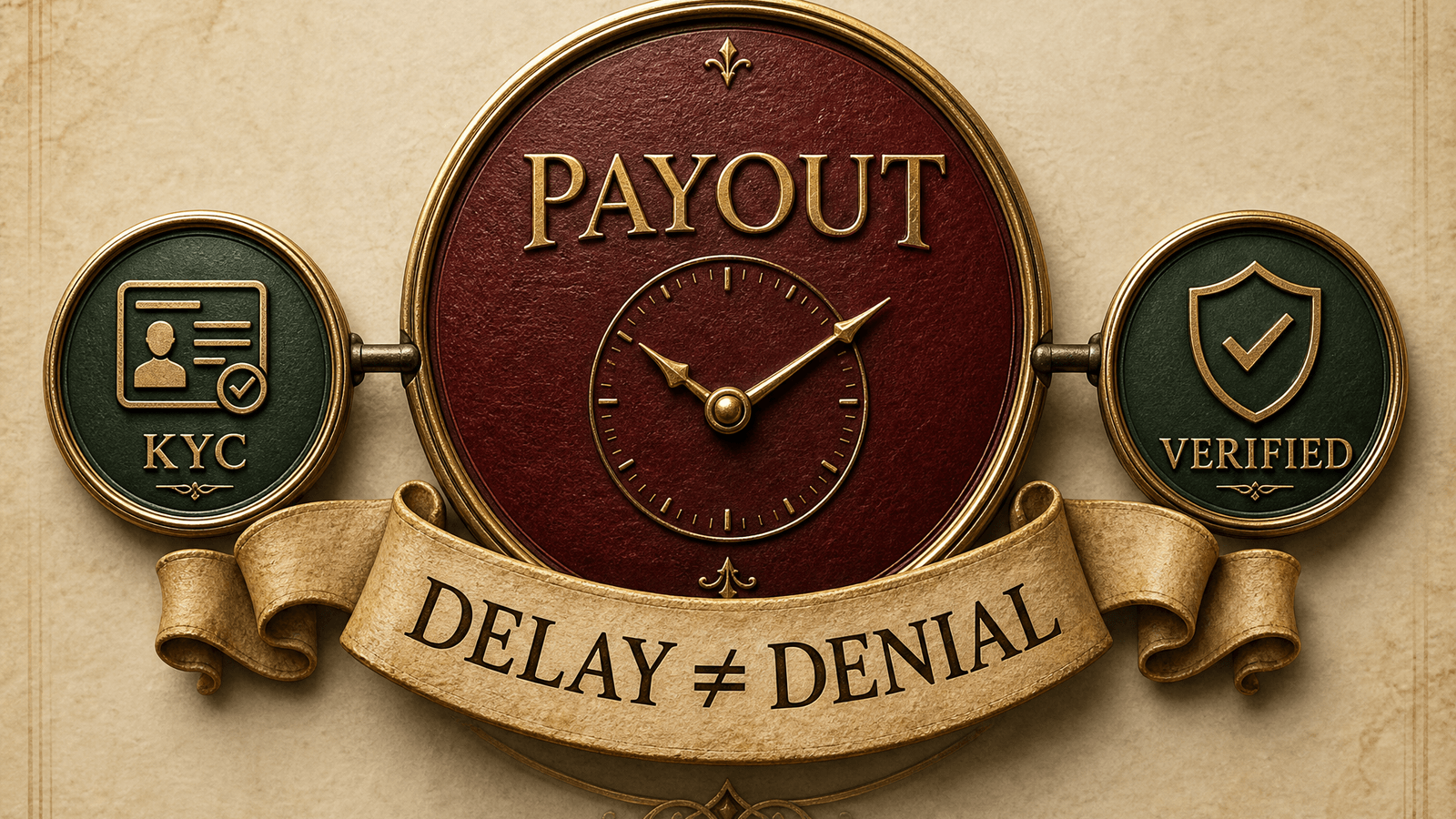
What actually causes prop firm payout delays?
Four causes account for nearly every prop firm payout delay, namely identity verification that was never completed earlier, a check confirming the payout destination belongs to the trader, a review of the trading that produced the profit, and a scheduled payout cadence the trader agreed to at signup.
- Identity checks that were never done. If a firm only asks for documents when you request money, your first withdrawal waits on a review that could have finished weeks ago.
- Destination verification. Confirming the receiving account belongs to you is separate from confirming who you are — standard anti-money-laundering practice, not suspicion.
- Rule review when money moves. Consistency limits, news-window rules and risk caps get checked at payout time, because that is when they matter.
- A cadence you agreed to. On-demand, weekly and bi-weekly are three different promises. Requesting on day three of a bi-weekly cycle is not a delay, it is early.
None of these four causes of a payout delay is sinister by itself. The worry is a firm that cannot tell you, in writing, which applies.
Why does KYC timing decide how fast your first payout clears?
KYC timing decides whether identity review sits inside a trader's first payout or finishes well before it. A firm that verifies identity at funded-account issuance completes the slow part while the trader is still trading. A firm that verifies at payout request stacks an unpredictable document review on top of the withdrawal itself.
There are only two moments a firm can realistically run know-your-customer checks, when it hands you a funded account or when you ask for money. Both are legitimate, but only one puts a document review directly in front of your first withdrawal.
Documents get rejected for glare, for an expired date, for a name that does not match. That is days, sometimes longer, and it lands exactly when you are least patient. Run the same review at issuance and the slowest step is already behind you.
So ask any firm one question before you pay. When do you run identity verification, at funding or at withdrawal? That answer tells you more about your real risk of a payout delay than any "instant payouts" banner does.
How can you tell a firm pays reliably before you hand over a fee?
You cannot audit a firm's operations from the outside. You can check whether it commits to specifics in public, starting with a named KYC stage, an exact minimum withdrawal, named cadences with their rules, a named payments provider, a registered legal entity, and a written policy for flagged payouts. Vagueness is the warning sign, not slowness.
Regulators publishing investor advisories keep pointing at the same pattern. Trouble starts where nothing was written down first.
| Question to ask | Weak answer | Strong answer |
|---|---|---|
| When is KYC run? | "As required" | A named stage |
| Minimum withdrawal? | Not published | An exact figure |
| Payout cadence? | "Fast payouts" | Named options with rules |
| Who processes payments? | An unnamed partner | A named provider |
| Who is the contract with? | A brand name | A registered entity |
| What happens to a flagged payout? | Silence | Held and reviewed, in writing |
A firm answering the right column decided its policy in advance. A firm answering the left column is deciding while you wait.

What has TBM Funded actually published about its payout terms?
TBM Funded is pre-launch, so these are published, committed terms, not a track record. Identity verification runs at funded-account issuance. The first payout opens after 14 days plus 3 trading days on the funded account. Minimum withdrawal is $250, and payouts are processed through Rise.
- KYC at issuance, not at withdrawal. It runs after Phase 2 clears, before funded credentials are issued.
- Two cadences, each with its trade-off stated. On-demand pays 60% on 2-Step, 70% on Rapid, with no processing fee. Bi-weekly pays 80% and 90%, with a 3% fee. You keep up to 90% and choose per request.
- The $250 minimum is measured on the amount actually withdrawn — your share after the split, before any fee.
- A flagged payout is held and reviewed, never silently denied. Breaching the 35% consistency rule holds that cycle's payout, not the account.
- The operating entity is TBM Capital L.L.C-FZ; challenge contracts are held by Tbmfunded Ltd., a Saint Lucia International Business Company. Every figure lives on pricing, how it works and trading doctrine.
Is a delayed payout the same as a denied one?
No. A payout delay means the money is still coming and something is being checked. A denial means a rule has been applied and that payout will not be paid. The two look identical on a dashboard, but they have different causes, different fixes, and different questions worth putting to support.
The distinction shows up in how a firm words its own policy. "Held pending review" is a delay with an exit. "Forfeited" is a decision. A firm that publishes which rule triggers which outcome has already told you where you stand. TBM's 35% consistency rule, for example, holds the payout for that cycle rather than ending the account.
If you are trying to work out which one you are looking at, our 12 reasons prop firms deny payouts covers the denial side in full. And if you have not bought a challenge yet, the pre-purchase checklist has the questions worth asking while you can still walk away.
What else do traders ask about payout delays?
Most follow-up questions are about timing rather than trust. They cover how long a first payout should take, why it is slower than later ones, and whether waiting means something is wrong. The answers below cover the five that come up most, and none of them require you to take a firm's word for anything.
How long should a prop firm payout actually take? There is no industry standard, so the number itself tells you very little. What matters is whether the firm publishes its cadence, its minimum, and the stage at which it runs verification. A firm that names all three is predictable even when it is not instant.
Why is my first payout slower than the ones after it? First payouts usually carry one-time checks that later ones do not. Those checks are identity verification, payout-destination confirmation, and a minimum holding period. At TBM that holding period is 14 days plus 3 trading days on the funded account. Those steps do not repeat.
Is a delayed payout a sign the firm is in trouble? Not by itself. Waiting is normal when a check is genuinely running. It becomes a warning sign when the firm will not tell you what is being checked or roughly how long it takes. The silence is the signal, not the wait.
Can I do anything to speed up my first payout? Complete identity verification the moment it is offered instead of waiting until you want money, and make sure the payout destination is in your own name. Those two steps remove the slowest and least predictable part of most first withdrawals.
What is the difference between a payout being held and being denied? A hold means the payout is under review and still payable. A denial means a rule has been applied against it and it will not be paid. A firm should tell you plainly which of the two you are in, and which rule put you there.
More answers sit in our full FAQ.
Key takeaways
- Most payout delays trace to four causes: late identity checks, payout-destination verification, a rule review triggered when money moves, and the cadence you already agreed to.
- KYC run at funded-account issuance clears the slowest step before you ever request money — ask any firm when they run it, at funding or at withdrawal.
- A trustworthy firm publishes specifics: a named KYC stage, an exact minimum, named cadences, a named provider, a registered entity, and a written policy for flagged payouts.
- A delay is not a denial. A held payout is still coming; a denied one has been ruled against.
- TBM Funded's published terms: KYC at issuance, first payout after 14 days plus 3 trading days, a $250 minimum, and payouts via Rise.
Risk disclaimer: Trading forex and CFDs carries real risk and can result in the loss of your capital. Prop firm challenges involve a fee and do not guarantee funding or income. Nothing here is financial, legal or tax advice — see our full Risk Disclosure.