12 Reasons Prop Firms Deny Payouts (Checklist)
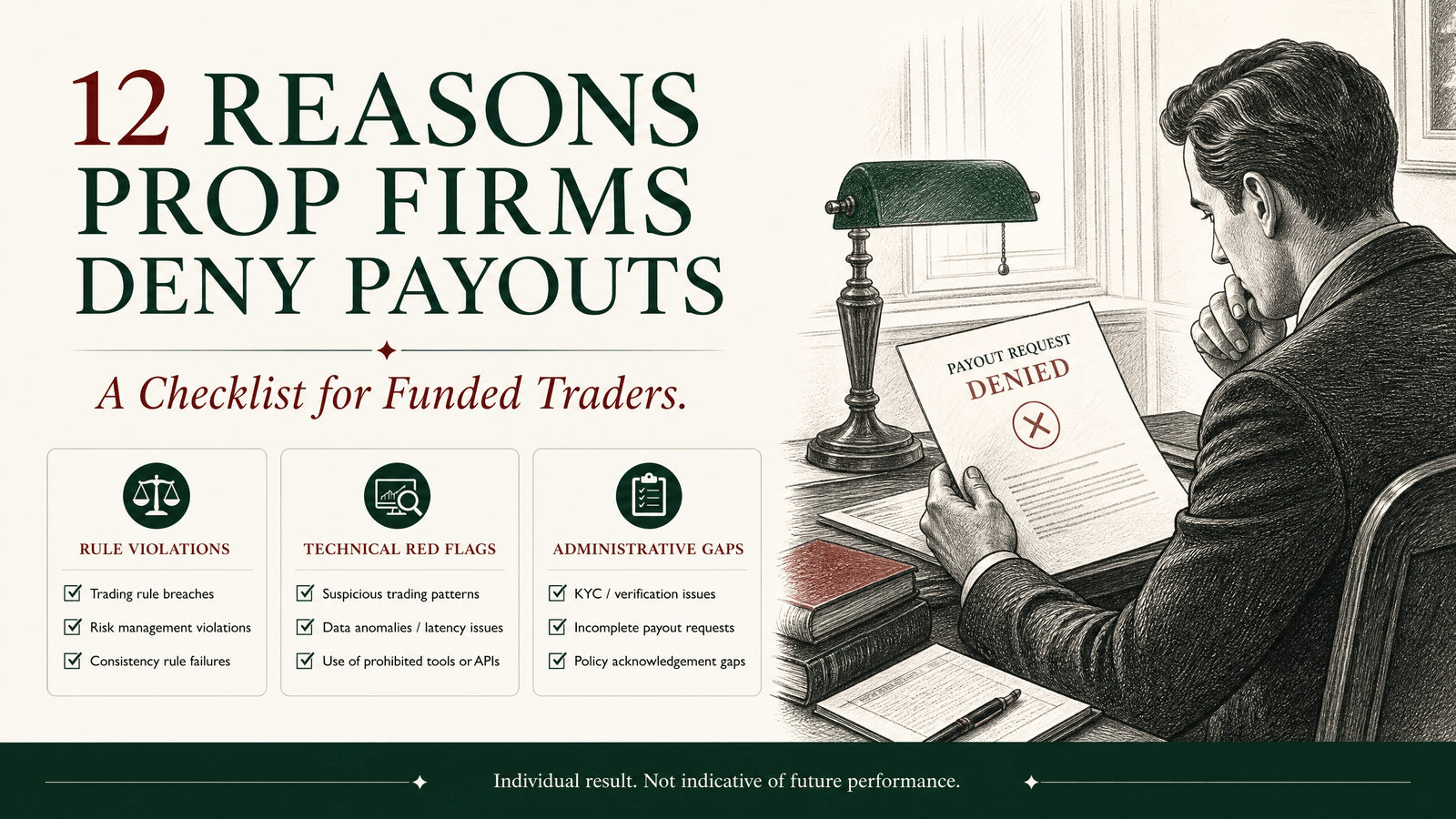
Prop firms deny payouts for reasons that fall into three buckets: rule violations (consistency breaches, news-window trades, cross-account hedging), technical red flags (latency arbitrage, copy-trading, unauthorized bots), and administrative gaps (KYC mismatches, missed minimum trading days, inactivity). Most denials are avoidable once a trader knows exactly what the firm's published rules say — and most firms don't make that easy.
Why Payout Denials Happen More Than Traders Expect
A funded evaluation account is a rules-based product. The firm isn't judging whether a trade was "good" — it's checking whether the account behaved inside a defined box. Traders who lose a payout almost always broke a rule they either never read, misunderstood, or assumed didn't apply to them. Below are the 12 categories that account for the overwhelming majority of denied or held payouts across the industry.
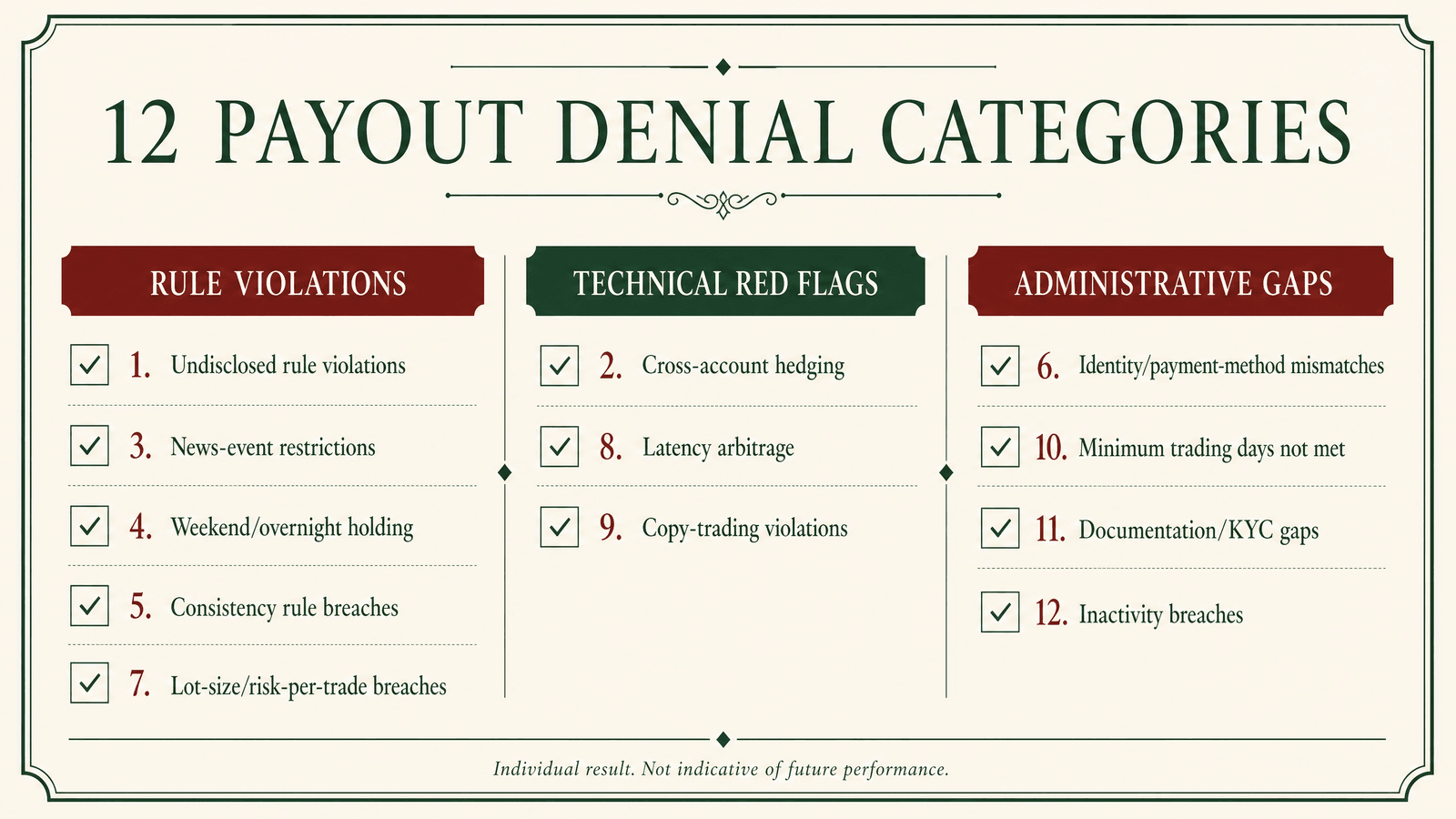
The 12 Most Common Payout Denial Triggers
| # | Trigger | What It Usually Looks Like |
|---|---|---|
| 1 | Undisclosed or buried rule violations | A rule exists only in a Discord pin, a T&C addendum, or a FAQ page — not in the core rule sheet the trader agreed to at checkout. |
| 2 | Cross-account hedging | The same trader (or a linked identity) opens opposing positions across two or more accounts to guarantee a payout regardless of market direction. |
| 3 | News-event restrictions | Trading, or holding a position open, through a high-impact release when the firm's rules define a blackout window around it. |
| 4 | Weekend or overnight holding violations | Positions left open past the firm's defined cutoff, even briefly, on a product that doesn't permit it. |
| 5 | Consistency rule breaches | One outsized day accounts for more of total profit than the firm's published consistency cap allows. |
| 6 | Identity/payment-method mismatches | The name on the trading account, the KYC document, and the payout wallet don't line up, or a payout is requested to a third-party wallet. |
| 7 | Lot-size or risk-per-trade breaches | A single order exceeds the maximum lot size, or risk on one trade exceeds the maximum loss-per-trade percentage. |
| 8 | Latency arbitrage patterns | Trading style exploits a lag between the firm's price feed and the live market rather than taking genuine market risk. |
| 9 | Copy-trading violations | Multiple accounts (own or shared) mirror identical entries/exits, which most firms treat as a single strategy gaming multiple payouts. |
| 10 | Minimum trading days not met | The account hit its profit target too fast, before satisfying the firm's minimum number of active trading days per phase. |
| 11 | Documentation/KYC gaps | Expired ID, unreadable proof of address, or incomplete verification submitted only after a payout is requested. |
| 12 | Inactivity breaches | The account sits untouched past the firm's defined inactivity window and is closed before a payout is ever processed. |
The rules you never saw are still rules you agreed to
Category 1 deserves its own callout because it causes the most disputes. Many firms publish a short, marketable version of their rules on the pricing page and a longer, stricter version inside the account dashboard or Discord server after purchase. A trader who only read the pricing page can violate a rule they had no practical way of finding. The fix isn't hoping this doesn't happen — it's confirming, before paying, that the full rule set (not a summary) is public and linked from the checkout page itself.
Technical patterns firms actively monitor
Latency arbitrage, copy-trading, and cross-account hedging (categories 2, 8, and 9) are grouped by risk teams because they share a common thread: the trader isn't taking directional market risk in the way the evaluation is designed to test. Firms typically detect these through timestamp correlation across accounts and price-feed comparison tools, not manual review — which is why traders are often surprised by a denial that references "abnormal trading patterns" without a single flagged trade looking wrong in isolation.
Administrative denials are the easiest to prevent
KYC gaps and payment-method mismatches (categories 6 and 11) are rarely about fraud — they're about firms not disclosing verification requirements until a payout is already requested, at which point a delay reads as a denial. This is also why payout method matters: firms that settle in crypto (commonly USDT) tend to have fewer cross-border transfer failures than firms relying on international bank wires — see our piece on why prop firm payments get declined for the mechanics behind that.
The Transparency Checklist: What a Trustworthy Firm Publishes Before You Pay
Use this before paying for any evaluation, regardless of which firm you're considering. A firm that meets this standard has nothing to hide about how payouts actually work.
- Full rule set is public and linked at checkout — not summarized on the pricing page and expanded later in a private dashboard.
- Consistency rule is stated as an exact percentage, with a clear explanation of what happens on a breach (a soft hold on that payout cycle is very different from account termination — the firm should say which).
- Drawdown type is disclosed separately for evaluation and funded stages. Static drawdown (fixed from a starting balance) during evaluation is common; what happens at the funded stage varies firm to firm — some keep the same static floor, others switch to trailing end-of-day drawdown measured against the account's peak balance — see our full explainer on static vs trailing drawdown and confirm which model the specific firm actually uses before assuming either. A trustworthy firm states this distinction explicitly — it should never be something a trader discovers after getting funded.
- News-event handling is defined in minutes, not vague language — e.g., a fixed blackout window around high-impact releases, with a clear statement of whether profit inside that window is excluded from the payout calculation or treated as a violation.
- Maximum lot size and max leverage per trade are numeric, not "reasonable risk management."
- EA/bot policy is explicit: what's allowed with proof of ownership on request, and what's banned outright (commercial EAs, HFT bots, arbitrage tools).
- Minimum trading days per phase are stated up front, before a trader can pass too fast and get flagged.
- Inactivity window is disclosed, along with what happens to an account (and any pending balance) if it's crossed.
- Payout mechanics are specific: cycle frequency, minimum withdrawal amount, and how many days after activation the first payout becomes eligible — including any caps on early payouts.
- KYC requirements are listed before purchase, not requested for the first time when a payout is due.
If a firm can't produce numeric, written answers to all ten of these before you pay, treat that as the finding — not the firm's word that "support will help you out." See How It Works and Pricing for how one firm publishes this before checkout.
FAQ
Why did my prop firm deny my payout? The most common reasons are a consistency rule breach (one day too large a share of total profit), a rule violation the trader didn't know existed, a KYC or payment-method mismatch, or a technical flag like cross-account hedging or copy-trading detection.
What is a consistency rule in prop trading and why does it matter for payouts? A consistency rule caps how much of an account's total profit can come from a single trading day, usually expressed as a percentage. It exists so a firm isn't paying out on one lucky trade rather than a repeatable strategy; breaching it typically triggers a hold or adjustment on that payout cycle rather than an automatic account termination.
Can a prop firm deny a payout after I already passed the evaluation? Yes. Passing the evaluation confirms the account met its profit target and risk limits during that phase — it doesn't exempt the funded account from ongoing rules like drawdown limits, inactivity windows, or KYC verification, all of which can still affect a payout.
What's the difference between static and trailing drawdown? Static drawdown is fixed against the account's starting balance and doesn't move as the account grows — common during the evaluation phase. Trailing drawdown recalculates against the account's highest-ever balance, so the maximum loss allowed shifts upward as profit grows. Which model applies once an account is funded varies firm to firm — some keep the evaluation's static floor, others switch to trailing — so check the specific firm's published rules rather than assuming either.
How do I know if a prop firm's payout policy is trustworthy before I pay? Check whether the full rule set, consistency percentage, drawdown type per stage, news-event policy, and payout SLA (frequency, minimum withdrawal, first-payout timing) are all published and linked before checkout. If any of these only appear after purchase, treat that as a risk signal.
More questions like these are answered in our full FAQ.
Risk disclaimer: Trading forex and CFDs carries real risk and can result in loss of your capital. Prop firm challenges involve fees and don't guarantee funding or income. This isn't financial, legal, or tax advice — see our full Risk Disclosure.
Last updated: July 12, 2026