How Much Does a Funded Account Really Cost?
A funded account doesn't cost its sticker price — it costs the sticker price times however many attempts it actually takes you to get funded. A $66 evaluation that takes two tries costs more than a $156 one you pass first time. The number on the pricing page is the floor, not the true cost.

Why the sticker price is the wrong number to compare
The entry fee is what you pay once, upfront, to attempt an evaluation. It is not what funding actually costs you if you don't pass on the first try. Every additional attempt — whether a fresh purchase or a discounted reset — adds to the real total, and the sticker price never shows you that number.
This is why comparing prop firms on entry fee alone is close to meaningless. A slightly higher fee attached to rules you can actually pass is cheaper, in real terms, than a lower fee attached to rules that force repeat attempts.
The actual formula for cost-to-funding
True cost = entry fee + (reset fee × number of resets needed)
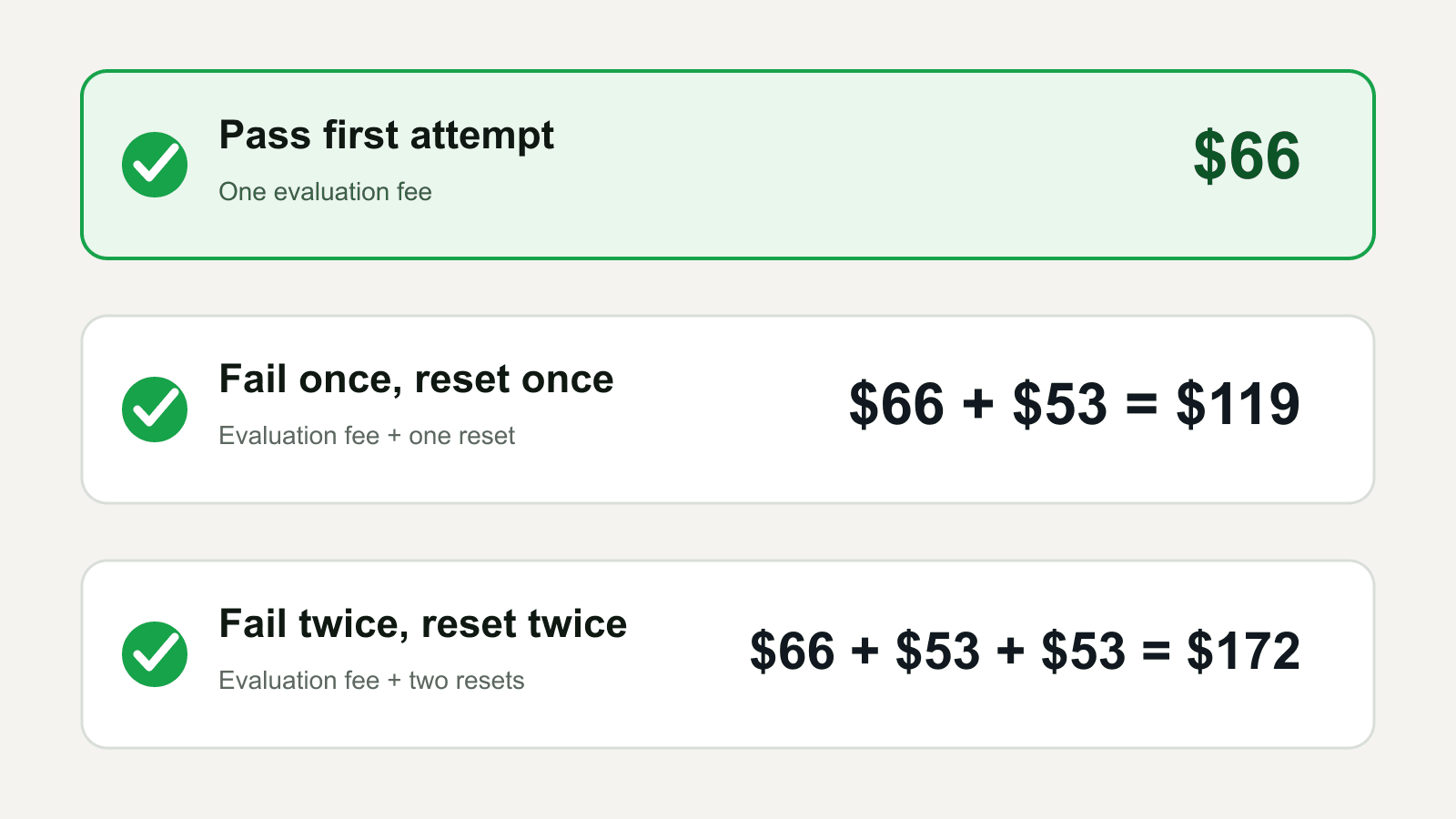
On TBM, a reset — restarting a failed evaluation at the same size — costs 80% of the standard fee, a flat 20% discount, not a free retry. Worked example on a Capo ($10,000, 2-Phase, $66 entry fee): pass first try, true cost is $66. Fail once and reset, true cost is $66 + $53 (20% off $66) = $119.
| Scenario | Entry fee | Resets needed | Reset fee (20% off) | True cost |
|---|---|---|---|---|
| Pass first attempt | $66 | 0 | — | $66 |
| Fail once, reset once | $66 | 1 | $53 | $119 |
| Fail twice, reset twice | $66 | 2 | $53 each | $172 |
What actually drives the number of attempts you need
The rules you're evaluated against decide how many attempts you're likely to need — not luck. A tighter drawdown limit, a shorter time window, or an unclear consistency rule all raise your real chance of a reset, which raises your true cost regardless of how cheap the entry fee looked. Position sizing discipline going in is the single biggest lever you control here — it's the difference between needing one attempt and needing three.
This is also why an evaluation with no time limit changes the math in your favor: you're not forced into a rushed second half of the evaluation that raises your odds of a breach. TBM's 2-Phase and Rapid evaluations both run with unlimited time — full current rules on How It Works.
How to actually estimate your own true cost before you buy
Start from your own trading history, not the pricing page. If you've never traded under a hard drawdown limit before, budget for at least one reset in your true-cost estimate — it's the honest number, not the optimistic one. If you've already proven you can trade within a fixed drawdown and daily loss limit, your realistic true cost is closer to the entry fee alone.
Either way, the size and product you choose from TBM's full lineup on Pricing should match what you'd actually pay if it takes you two tries, not what looks cheapest on a first read. When you're ready, start your challenge at the size your real trading — not your budget — actually supports.
Quick questions
Is a reset the same price as a new challenge? No — a reset is 20% cheaper than the standard entry fee for the same size and product. It's still a full separate purchase, not a free retry.
Does a higher entry fee always mean a higher true cost? No. A higher entry fee with rules you can realistically pass on the first attempt can have a lower true cost than a cheap entry fee with rules that force repeat attempts.
What's the single biggest factor in how many attempts I'll need? Your own risk discipline going in — particularly position sizing and respecting your stop distance — matters more than which firm you choose, though the rules themselves (drawdown type, time limit) also shift the odds.
Does TBM's evaluation have a time limit that could force a rushed attempt? No — both 2-Phase and Rapid run with unlimited time, so there's no clock forcing decisions in the back half of an evaluation.
More questions like these are answered in our full FAQ.
Risk disclaimer: Trading forex and CFDs carries real risk and can result in loss of your capital. Prop firm challenges involve fees and don't guarantee funding or income. This isn't financial, legal, or tax advice — see our full Risk Disclosure.