What Is a Trading Plan? Why Prop Firms Care
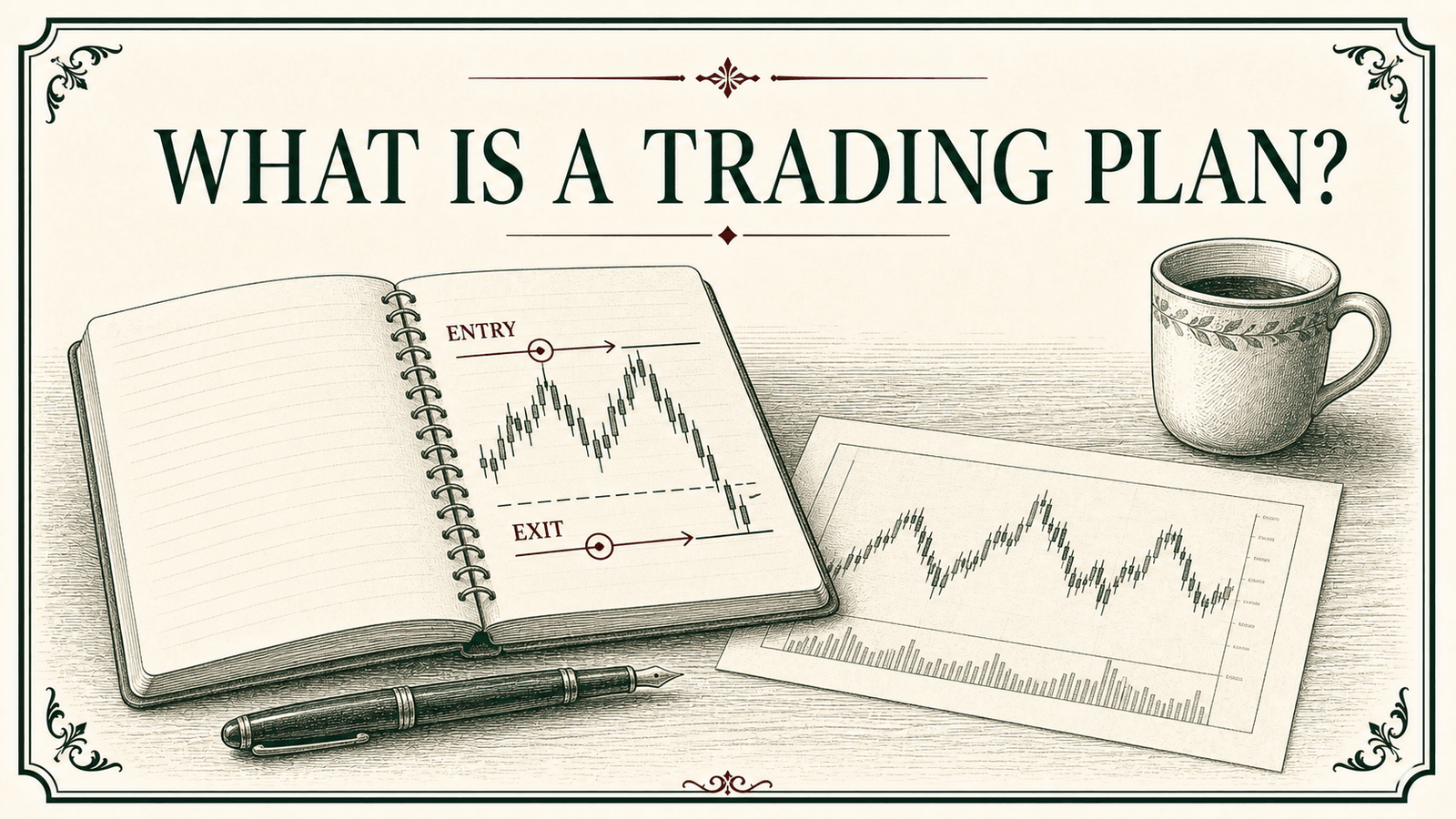
So what is a trading plan, and why do prop firms care so much about whether you actually have one? A trading plan is just a written set of rules for how you enter, exit, and size every trade — decided before you're staring at a live chart with real money on the line.
No plan means every decision gets made in the moment, under pressure, usually badly. Prop firms like TBM Funded structure their evaluation rules around exactly this gap. The rules aren't there to trip you up. They're there to reward traders who show up with an actual plan.
What Is a Trading Plan, Really?
Forget the textbook version. A written trading plan is the answer to four questions, decided before you place a single trade:
- Entry rules — what has to happen on the chart before you click buy or sell? Not a feeling. A specific, repeatable condition.
- Exit rules — where's your stop-loss, and where's your target? Decided before you're in the trade, not while you're watching it move against you.
- Risk per trade — how much of your account can this one trade cost you if you're wrong? A number, not a vibe.
- Position sizing — given that risk number, how many lots do you actually put on?
If you can't answer all four in one sentence each, you don't have a plan. You have a hunch with a chart open.
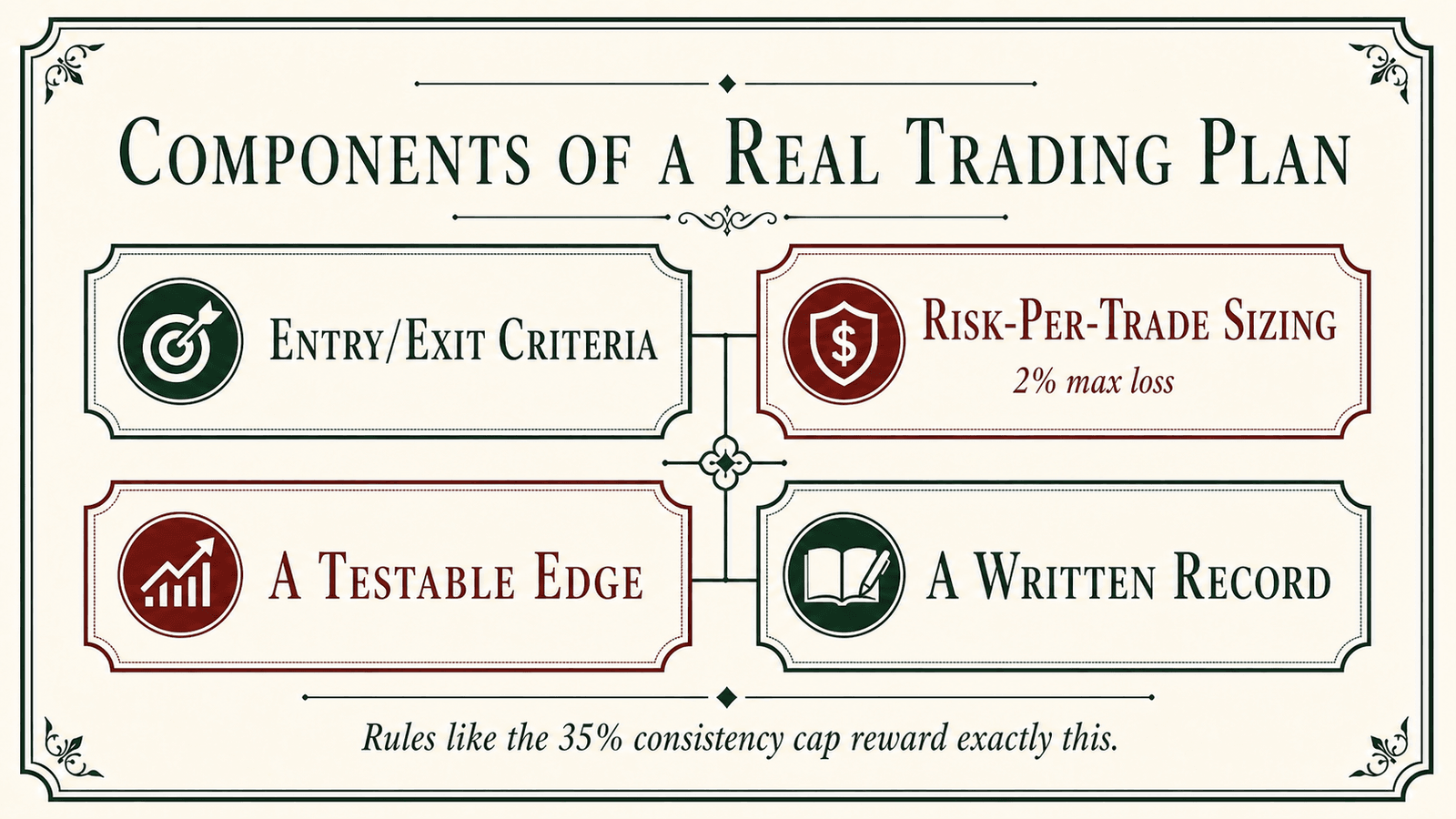
| Component | The question it answers | What it looks like in practice |
|---|---|---|
| Entry rules | When do you get in? | A specific, repeatable setup — not "it felt right" |
| Exit rules | Where do you get out? | Stop-loss and target set before entry, not adjusted mid-trade |
| Risk per trade | How much can this trade cost you? | A fixed, capped % of your account — non-negotiable |
| Position sizing | How big is the trade? | Lot size calculated backward from your risk number |
| A written record | Did it actually work? | A trade log you review, not memory |
Why Do Prop Firms Care So Much About Your Trading Plan?
A firm funding you isn't betting on one trade. It's betting on whether you can do this again, on a random Tuesday, when nothing exciting is happening. A trader with a real plan produces boring, repeatable outcomes. A trader without one produces one great week, then a blown account.
Evaluation rules exist to tell those two people apart before real payouts are on the line. That's also the entire point of risk management as a discipline — it's not about avoiding losses, it's about making sure no single decision can end the account.
This is why challenge rules read as "restrictive" to a lot of first-timers. They're not restrictive. They're a filter for exactly the behavior a real trading plan already produces on its own.
How TBM's Rules Reward Having an Actual Plan
Take three of TBM Funded's real rules and look at what each one is actually testing for.
Max loss per trade — 2% per position. If your risk-per-trade number is already under 2%, this rule changes nothing for you. It only bites the trader whose "plan" was never written down — the one sizing trades by feel and occasionally going all-in on a setup they were "sure" about. A real plan makes this rule invisible.
Minimum trading days — 5 per phase on the 2-Phase Challenge, 3 per phase on Rapid. A single all-in trade can technically hit a profit target. It just doesn't prove anything. Spreading your pass across multiple trading days is the rule's way of asking: did you do this on purpose, repeatedly, or did you get lucky once? A trader following real entry and exit rules clears this without noticing — the days add up naturally.
Consistency rule — no single trading day above 35% of total profit at payout. Same logic as minimum trading days, applied at payout instead of at pass. One outlier day doesn't count as proof of a repeatable edge. If your plan is genuinely repeatable, your profit naturally spreads across more than one big day — the rule just confirms what a real plan already produces. We've broken this one down fully in the consistency rule explainer, including what happens if you trip it.
None of these three rules punish you for having a bad day. They check whether your good days came from a process or from luck — which is the whole idea behind having a real trading plan in the first place.
What This Looks Like on Day One
You don't need a 40-page document. You need four numbers and one sentence: what you enter on, where you exit, what percentage you risk, and how you size the trade to match that risk. Write it down before your first session, not after your first loss.
If you're trading with automation, the same principle applies — TBM allows personally-owned EAs with proof of ownership, because the plan has to be yours. Third-party or commercial EAs, HFT bots, and arbitrage EAs are banned outright, since outsourcing your decisions to a black box someone else built isn't a trading plan.
Full rules for both products — 2-Phase Challenge and Rapid — are on How It Works. Build your risk-per-trade number around the real targets and drawdown limits there, not the other way round.
Quick questions
Do I need a trading plan before I start a challenge? You don't submit one anywhere, but yes — trade without one and TBM's rules (max loss per trade, minimum trading days, consistency) will eventually catch what your plan should have prevented.
What's the difference between a trading plan and a trading strategy? A strategy is your edge — the setup you actually look for. A plan is everything around it: how much you risk, how you size it, when you exit, and how you track whether it's working.
Does having a trading plan guarantee I'll pass the evaluation? No. Nothing guarantees a pass, and this isn't a promise of profit or funding. A plan just means your outcome comes from a repeatable process instead of one lucky, or unlucky, session.
Can I trade with an automated system instead of my own plan? Only if it's genuinely yours. TBM allows personally-owned EAs with proof of ownership. Third-party or commercial EAs, HFT bots, and arbitrage EAs are banned.
Where do I find the exact evaluation numbers before I write my plan? Pricing and How It Works list the current targets, drawdown limits, and daily loss caps for both products. More rule breakdowns like this one live in the full FAQ.
Risk disclaimer: Trading forex and CFDs carries real risk and can result in loss of your capital. Prop firm challenges involve fees and don't guarantee funding or income. This isn't financial, legal, or tax advice — see our full Risk Disclosure.