Why Time Limits Make 'Cheap' Challenges Expensive
A time-limited challenge forces a decision a good trader shouldn't have to make: trade your normal size, or rush to beat a deadline. That second option is exactly how a cheap entry fee turns into a second entry fee.

What a time limit actually does to your decision-making
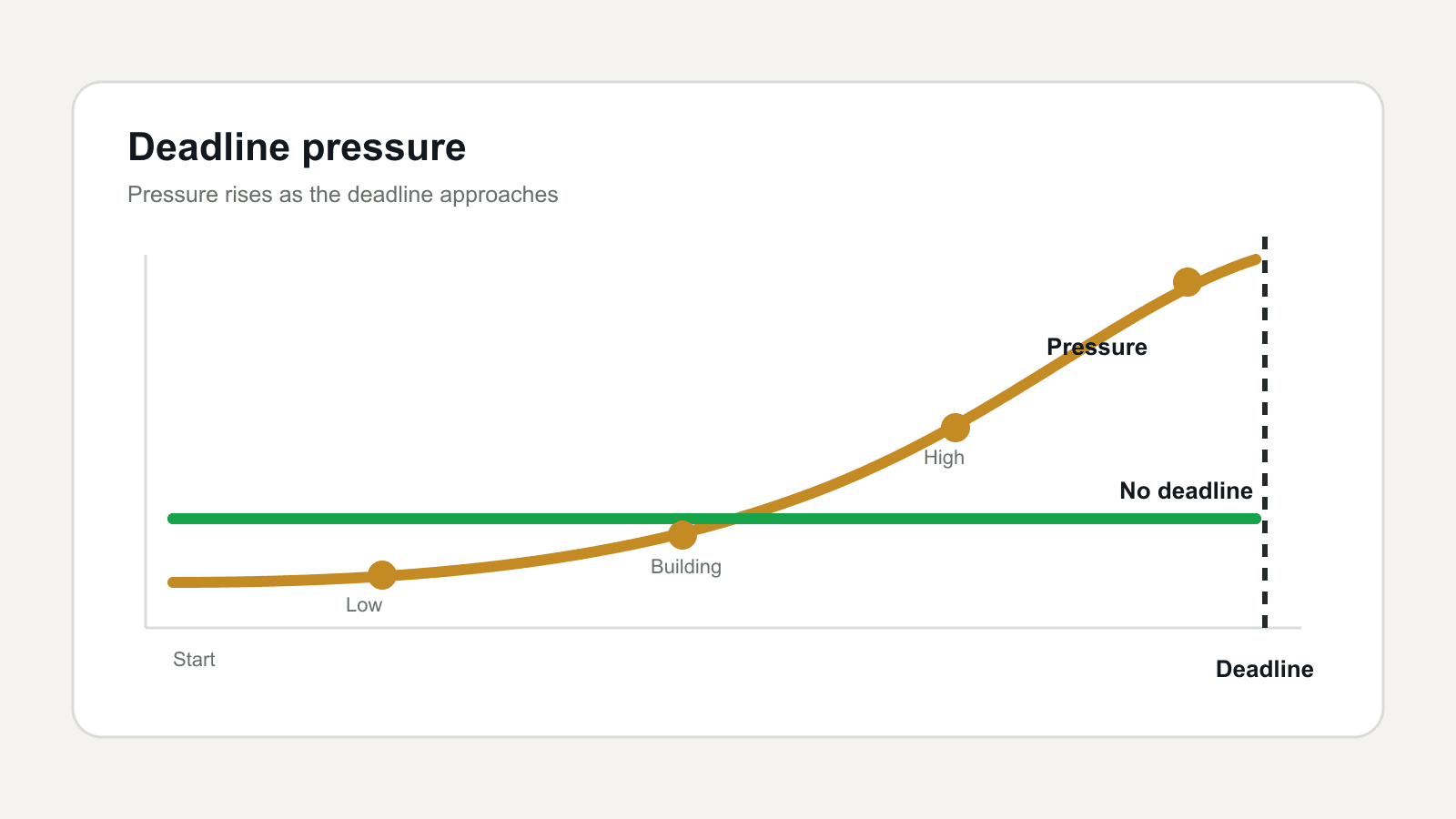
A fixed evaluation window — a set number of days per phase, whatever a specific provider sets it at — doesn't change your trading skill. It changes your patience under pressure, on exactly the days pressure is most likely to cause a mistake: the last few before a deadline. A trader who'd normally wait for a clean setup starts taking marginal ones because the clock, not the chart, is now driving the decision.
How this turns into a real cost, not just a risk
A rushed trade taken to beat a deadline is statistically more likely to be a worse trade — bigger size, weaker setup, tighter emotional control — all the conditions that raise your odds of a drawdown breach. A breach means a reset or a fresh purchase. The time limit itself doesn't cost anything directly; the decisions it forces you into are what raise your true cost, the same true cost math that applies to any repeat attempt.
Why TBM removed the clock entirely
TBM's 2-Phase and Rapid evaluations both run with unlimited time — no 30-day window, no deadline pressure on either phase. You still have to hit the same profit targets and respect the same drawdown limits; you just never have to choose between your normal process and a countdown. Full current rules are on How It Works.
| With a fixed time limit | TBM (unlimited time) | |
|---|---|---|
| Deadline pressure | Present, especially near the window's end | None |
| Incentive to oversize late | Yes, to catch up before the deadline | No |
| Effect on true cost | Raises breach odds, raises reset likelihood | Unaffected by timing |
What unlimited time doesn't mean
It doesn't mean the evaluation gets easier — the profit targets and drawdown limits are exactly as strict either way. It means the pace at which you clear them is entirely yours to set. A trader who needs six weeks to hit Phase 1 cleanly loses nothing by taking six weeks; a trader who clears it in four days loses nothing by moving fast either.
Quick questions
Does removing the time limit make TBM's evaluation easier to pass? No — profit targets and drawdown limits are unchanged. What changes is that you're never forced to rush a decision to beat a deadline.
Is a 30-day time limit common across the industry? It's a common structure among evaluation-based providers — always check a specific firm's actual published rules rather than assuming a standard number applies.
Can I take as long as I want on a TBM evaluation? Yes — both 2-Phase and Rapid have no time limit on either phase. You set the pace.
How does a time limit actually raise my true cost? Indirectly — by pressuring rushed, oversized trades near a deadline, which raises your odds of a drawdown breach and therefore a reset or a fresh purchase.
More questions like these are answered in our full FAQ. Ready to trade on your own timeline? Start your challenge — no clock attached.
Risk disclaimer: Trading forex and CFDs carries real risk and can result in loss of your capital. Prop firm challenges involve fees and don't guarantee funding or income. This isn't financial, legal, or tax advice — see our full Risk Disclosure.