Why Do Most Traders Fail Prop Firm Challenges? (2026)
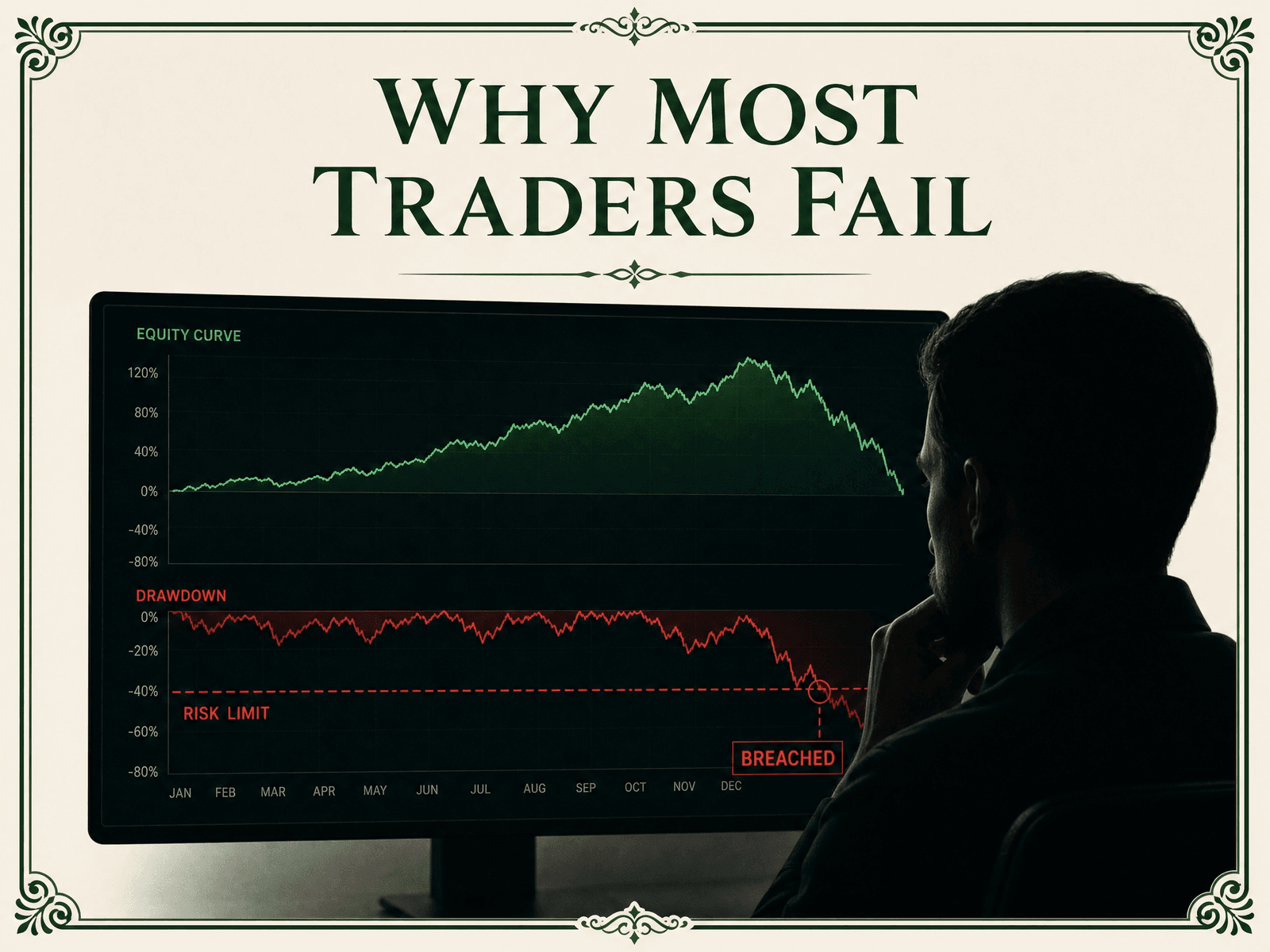
Most people who fail a prop firm challenge weren't bad traders. They were undone by five predictable, structural mistakes — not bad luck.
If you're asking why do most traders fail prop firm challenges, the honest answer isn't "the market got them." It's that the rules of an evaluation are genuinely different from the rules of normal trading, and almost nobody reads them closely enough before they start.
This isn't firm-specific. Every serious prop firm runs some version of a profit target, a drawdown limit, and a minimum trading period. The traders who pass aren't the ones with the best strategy in the room. They're the ones who understood the rulebook as well as they understood their charts — the same habit good investor education resources push for long before anyone pays for a challenge.
Why do most traders fail prop firm challenges? It's rarely the strategy
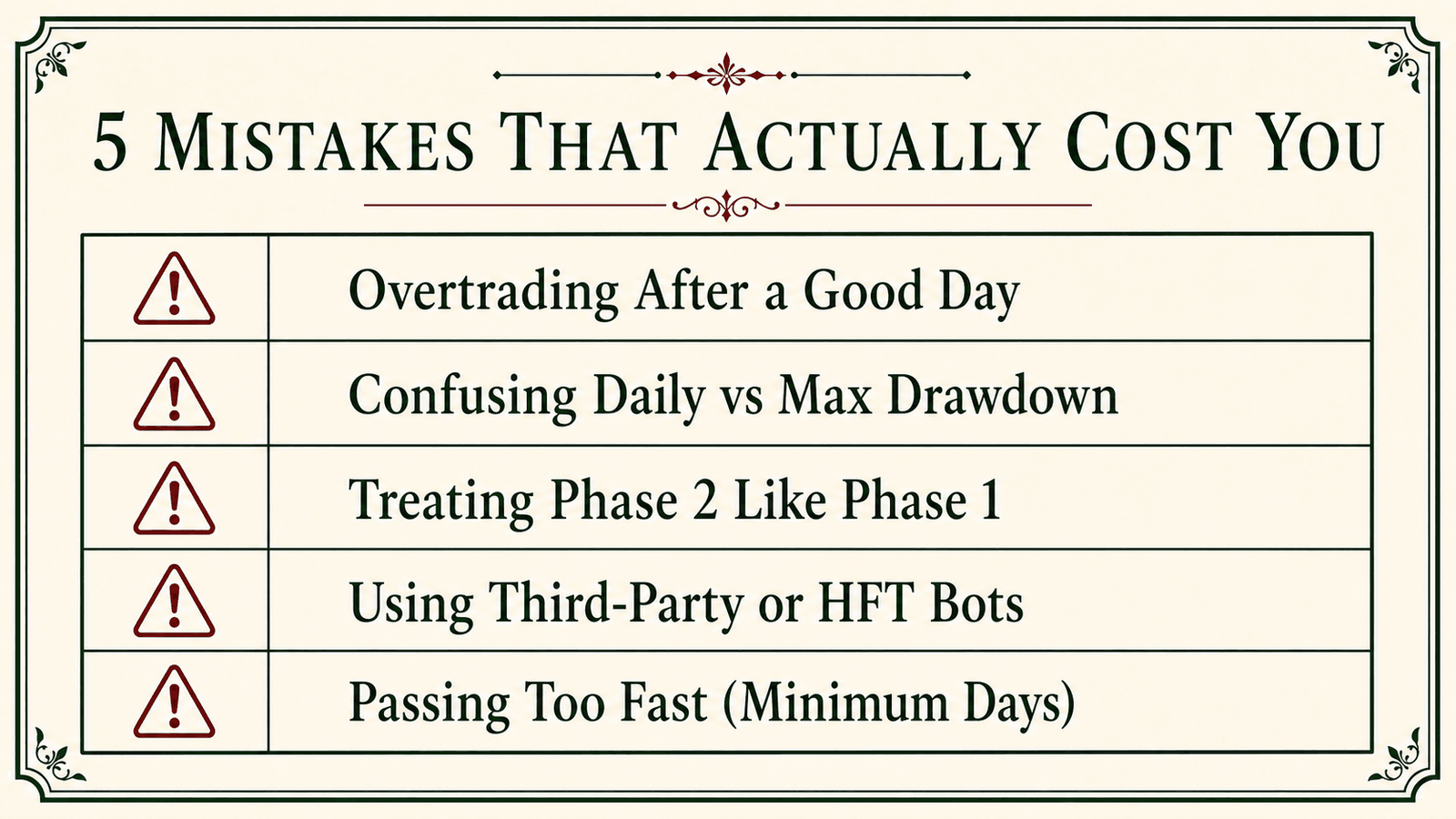
Ask any prop firm's risk desk what actually kills accounts, and you'll hear the same five things over and over. None of them are "the trader couldn't read a chart." All five are behavioral or comprehension failures — the kind you can fix before you ever pay for a challenge.
1. Hitting the profit target fast, then getting greedy
This is the single most common way an account dies. You hit your phase target in a week instead of a month. You feel unstoppable. So instead of stopping, you keep pushing size to "bank a buffer" — and one oversized session wipes out the cushion and breaches max drawdown.
The target isn't a floor. It's a finish line. Once you've hit it, the smartest trade is often no trade at all until the phase actually closes out — basic risk management doesn't stop mattering just because you're ahead.
2. Treating daily drawdown and max drawdown as the same limit
This is the mix-up that catches even experienced traders. Daily drawdown and max drawdown are two separate ceilings, measured differently, and breaching either one ends your evaluation. You can be sitting comfortably inside your max drawdown for the whole month and still get closed out because one bad session alone blew past your daily limit.
Read both numbers on day one, not after a rough afternoon. If you want the full breakdown of how these limits behave differently once you're funded too, static vs trailing drawdown is worth ten minutes of your time.
3. Trading Phase 2 exactly like Phase 1
Phase 2 targets are usually smaller than Phase 1's for a reason — the firm isn't testing whether you can hit a number anymore, it's testing whether you can do it again without a mulligan. Traders who ignore that and keep swinging Phase-1-sized risk in Phase 2 often blow the smaller drawdown cushion chasing a target that never needed that much risk in the first place.
Phase 2 rewards a boring, repeatable process. That's the actual thing being graded — the same instinct a funded-stage consistency rule exists to catch later, just earlier in the funnel.
4. Running someone else's EA or a bot instead of your own strategy
Most firms explicitly ban third-party or commercial expert advisors, HFT bots, and arbitrage EAs — and for good reason: those tools exploit pricing quirks the firm never intended to fund, and it's an instant-termination offense almost everywhere. A personally-owned EA that you built and can prove ownership of is usually fine. A bot you bought off a Telegram channel to "guarantee the pass" is the fastest way to lose your fee and your account in the same week.
If a strategy sounds too automated and too certain, read the EA policy before you plug it in.
5. Rushing past the minimum trading days requirement
Every serious challenge has a minimum number of trading days per phase — it exists so the firm isn't funding one lucky session. Traders who hit their target on day two or three often assume they're done, request the next phase early, and get rejected for not meeting the day count. It's not a punishment. It's just a rule nobody read.
Common mistakes, mapped to what actually happens
| Mistake | Why it feels smart in the moment | What actually happens |
|---|---|---|
| Push size after hitting target early | "I have a buffer now, why not add more" | One bad session wipes the buffer and breaches max drawdown |
| Confuse daily DD with max DD | "I'm nowhere near my overall drawdown limit" | A single rough day alone breaches the daily limit and ends the evaluation |
| Trade Phase 2 like Phase 1 | "Same strategy, just keep going" | Oversized risk on a smaller cushion blows the account before the smaller target even matters |
| Run a third-party/commercial EA or bot | "It guarantees the pass" | Instant termination for a banned tool, fee lost |
| Ignore minimum trading days | "I hit the number already" | Request denied — the day count wasn't met even though the profit was |
TBM's own numbers, as a concrete example
Every prop firm's exact numbers differ, but seeing real ones makes the traps above easier to picture. At TBM Funded, the 2-Phase Challenge runs an 8% Phase 1 target and a 5% Phase 2 target, a 10% max drawdown that's static during the evaluation (locked to your starting balance, not your peak), a 5% daily drawdown, a 5-trading-day minimum per phase, and no time limit on either phase — up to 80% profit split (60% on-demand, 80% bi-weekly).
2-Phase Rapid is tighter and faster: 6% targets on both phases, a 6% max drawdown (trailing end-of-day during the evaluation), 3% daily drawdown, a 3-trading-day minimum, and — like 2-Phase — no time limit on either phase.
Notice the daily and max drawdown numbers are always listed separately — that's mistake #2 above, made concrete. On the 2-Phase Challenge, you could be well inside your 10% max drawdown and still get closed out by one session that alone crosses the 5% daily limit. They're not the same fence.
One more thing worth flagging honestly: TBM's site-wide profit-split claim is "up to 90%" because Rapid pays up to 90% (70% on-demand, 90% bi-weekly) and 2-Phase pays up to 80% (60% on-demand, 80% bi-weekly) — the exact number always depends on which product you're trading and which payout cadence you choose. Full current numbers for both products live on How It Works, and the complete 2-Phase rulebook is broken down separately in our 2-Phase Challenge rules guide.
So how do you actually pass?
Nothing above is exotic advice. It's mostly: read the rulebook before you trade it, and don't let one good day change your risk per trade. Most of it comes down to plain trading discipline — doing the boring thing on the day you least feel like doing it.
- Know your daily drawdown and max drawdown as two separate numbers before your first trade, not after a scare
- Treat your profit target as a stop sign, not a green light to size up
- Keep Phase 2 risk the same as — or smaller than — Phase 1, since the target is usually smaller too
- If you use automation, confirm it's personally owned and disclosed, not a bought "guaranteed pass" bot
- Track your trading days like you track your P&L — the day count matters as much as the number
None of this requires a better strategy. It requires trading the account you actually have, under the rules that actually apply to it.
Quick questions
Is failing a prop firm challenge usually about strategy or behavior? Behavior, most of the time. Firms see the same five patterns repeat — overtrading after a fast target, drawdown confusion, EA violations, rushed minimum days — far more often than "the strategy just didn't work."
Are daily drawdown and max drawdown really separate limits? Yes, always treat them as two different fences. You can be completely fine on one and still breach the other in a single bad session — that's exactly how a lot of otherwise-solid evaluations end.
Can I use an EA or trading bot during a challenge? Usually only if it's personally owned and you can show that. Third-party, commercial, or HFT/arbitrage EAs are banned outright at most firms, TBM included, and using one is grounds for instant termination.
Why would a firm reject me even after I hit my profit target? Almost always the minimum trading days requirement. Hitting the number early doesn't waive the day count — you still need to trade the minimum number of days per phase.
Does Phase 2 really need a different approach than Phase 1? Yes. The target is usually smaller because Phase 2 is testing whether you can repeat your results, not whether you can hit a bigger number. Carrying Phase 1-sized risk into Phase 2 is one of the more common ways traders blow a smaller drawdown cushion late in the process.
More rule questions like these are answered in our full FAQ.
Risk disclaimer: Trading forex and CFDs carries real risk and can result in loss of your capital. Prop firm challenges involve fees and don't guarantee funding or income. This isn't financial, legal, or tax advice — see our full Risk Disclosure.