Instant Funding vs Evaluation Prop Firm: What to Know
Instant funding vs evaluation prop firm is the first fork in the road for anyone shopping for a funded trading account, and most comparison pages skim past it to sell you whichever model they happen to offer.
Here's the honest version. One model gets you "funded" the same day you pay, for a higher fee and usually a lower cut of profits. The other makes you prove yourself first, for less money upfront, before it hands you a bigger account and a bigger split. Neither is a scam. They're just different bets.
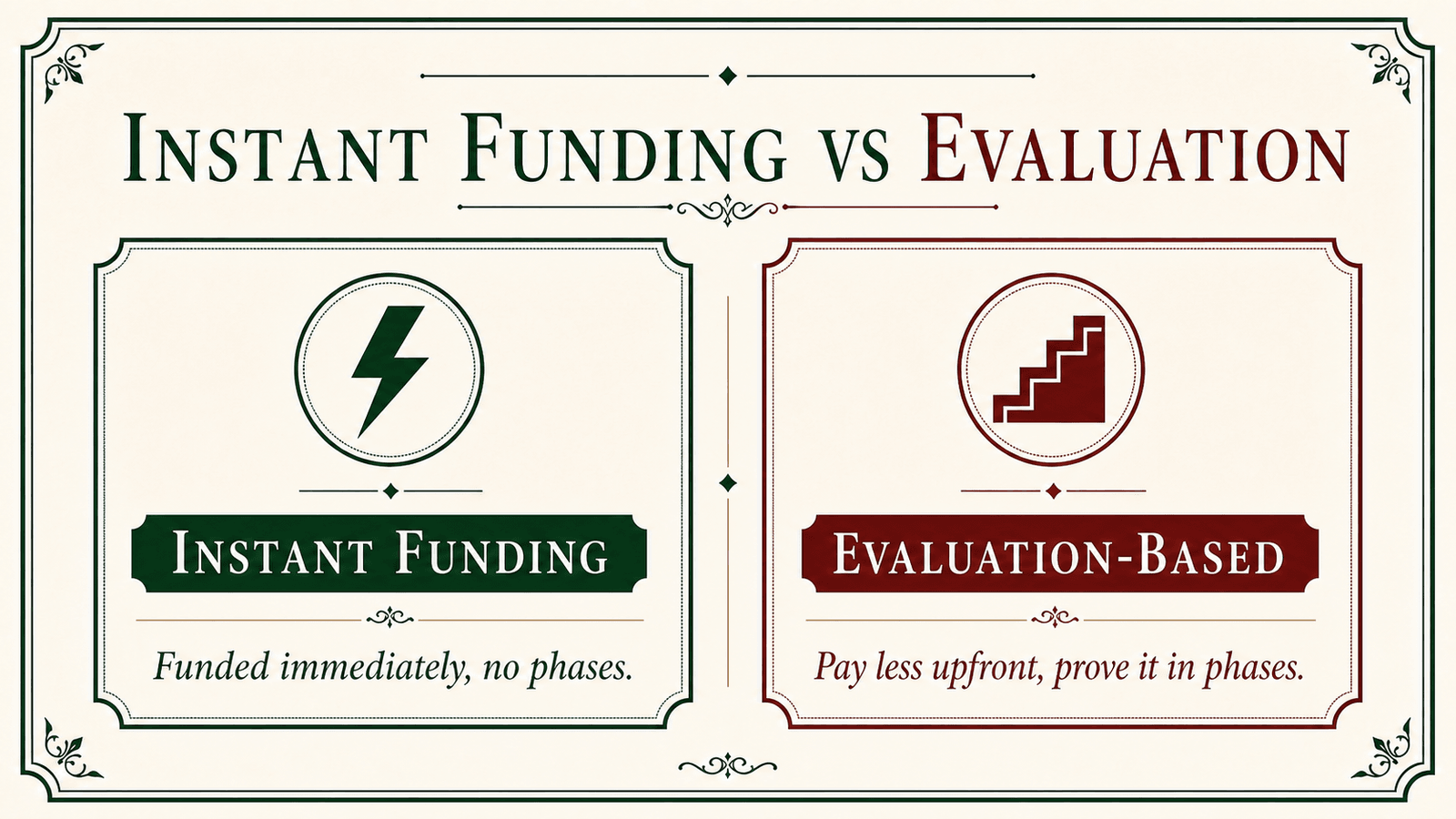
What "instant funding" actually means
An instant funding account skips the testing phase that most proprietary trading firms use to filter traders — there's no evaluation at all. You pay a fee, the firm activates a "funded" account immediately, and you start trading against its drawdown rules from day one — no profit target to hit first.
Sounds great. But the firm still needs to protect its own capital, so the tradeoff shows up somewhere else. Usually it's a higher fee for the same account size, a lower profit split until you clear an early milestone, and a trailing drawdown that starts moving against you from your very first trade — there's no "locked to your starting balance" grace period, because there was never an evaluation to lock it during.
Some firms also cap your first payout, or require a minimum number of trading days before you can withdraw anything at all, even though the account was "instant." Read the payout terms before the marketing page, not after.
What "evaluation-based" funding means
This is the older, more familiar model. You pay a smaller upfront fee to attempt a challenge — usually one or two phases, each with a profit target you have to hit while staying inside a drawdown limit. Clear the phases, and the firm moves you to a funded account.
You're paying less to try, but you're paying with time and effort instead. If you fail the evaluation, you lose the fee and have to buy another attempt. If you pass, you generally get a friendlier drawdown rule during the evaluation itself (locked to your starting balance, not chasing your account's highs) and a stronger profit split once funded, because you've already shown the firm you can trade inside its box.
Instant funding vs evaluation prop firm: the real tradeoffs
Neither model is "better" in the abstract — it depends what you're optimizing for.
- Speed vs. cost. Instant funding gets you live faster. Evaluation-based funding usually costs less to attempt, but you're spending days or weeks proving yourself before a single funded payout is possible.
- Risk to your fee. With evaluation-based funding, your entry fee is smaller, so a failed attempt stings less. With instant funding, you're often paying more upfront for capital you might lose access to just as fast if you breach the drawdown on day one.
- Drawdown structure. Evaluation-based accounts typically run static drawdown — locked to your starting balance — during the challenge phase. What happens to that floor once you're funded varies by firm; check the specific rules before assuming (TBM Funded's own model is below). Instant funding accounts often trail from the very first trade, since there's no evaluation period to hold the floor steady.
- Profit split. Evaluation-based firms tend to reward the phases you clear with a higher split once funded. Instant funding firms sometimes start you lower and raise the split after an early milestone (say, your first few payouts), so read the fine print on when the "headline" split actually kicks in.
- Proof of skill. An evaluation is, functionally, a stress test — it filters out accounts before real payouts are on the line. Instant funding skips that filter, which is exactly why firms price and structure it more conservatively on the back end.
Here's the comparison in one table:
| Instant funding | Evaluation-based funding | |
|---|---|---|
| Time to "funded" | Same day | After passing 1-2 phases |
| Typical upfront fee | Higher | Lower |
| Drawdown during evaluation | None — trailing from day one | Usually static, locked to starting balance |
| Drawdown once funded | Varies by firm | Varies by firm — TBM Funded uses static |
| Profit split at start | Often lower until a milestone | Often higher once you pass |
| What you're risking | A bigger fee, faster | A smaller fee, more attempts |
Where TBM Funded fits
TBM doesn't sell instant funding — all three TBM products are evaluation-based, so we're one example of that side of the table, not a neutral referee.
The 2-Phase Challenge runs an 8% then 5% profit target, 10% max drawdown (static during the evaluation and once funded), 5% daily drawdown, a 5 trading-day minimum, no time limit on either phase, and an 80% profit split once funded. 2-Phase Rapid targets 6% on each of two phases, with a tighter 6% max drawdown (trailing end-of-day during the evaluation, static once funded), 3% daily drawdown, a 3 trading-day minimum, no time limit either, and a 90% profit split. Full detail on both, tier by tier, lives on our pricing page.
On both, the funded account is still simulated capital with real payouts — you never deposit your own money to trade it, you just pay the one-time evaluation fee. Funded traders are on a 35% consistency cap (a soft hold, not a denial), and payouts follow whichever cadence you request — on-demand at no fee, or bi-weekly at the higher split with a 3% fee — with a $250 minimum per request, starting 14 days and 3 trading days on the funded account itself — evaluation days don't count toward those 3. TBM Capital L.L.C-FZ is the operating entity; challenge contracts are held by Tbmfunded Ltd., a Saint Lucia International Business Company.
If you want to see exactly how the evaluation-to-funded path works step by step, our funded trader guide walks through it, and the full 2-Phase rulebook covers every line of the fine print before you pay.
So which one should you actually pick?
If you're confident in your edge and want to skip the qualifying phase, instant funding trades a higher fee (and usually a stricter early drawdown) for speed. If you'd rather pay less to find out whether an account survives your strategy before real money-shaped payouts are on the table, evaluation-based funding is the more forgiving on-ramp.
Whichever model you're looking at, check the drawdown type before you check the profit split headline — it decides more outcomes than any other single rule. Our piece on static vs. trailing drawdown breaks down exactly how that switch works and why it matters more once you're funded than it did during the evaluation.
Quick questions
Is instant funding riskier than evaluation-based funding? Riskier for your fee, usually — you're often paying more upfront, and a day-one trailing drawdown gives you less room to make a mistake before you lose the account.
Does evaluation-based funding always mean two phases? No — and TBM runs one itself. TBM's 1-Step clears a single 10% target, while the 2-Phase Challenge and 2-Phase Rapid each use two. The number of phases varies firm to firm, so always check the exact structure before paying.
Can an evaluation-based account still have a trailing drawdown? Not on TBM's 2-Phase Challenge or 1-Step — both stay static, locked to your starting balance, through the evaluation and once funded. 2-Phase Rapid is the exception during the evaluation: its drawdown runs trailing end-of-day, then switches back to static once funded — same as 2-Phase, so no TBM product trails after you're funded.
Which model gets you paid faster? Instant funding gets you a "funded" label faster, but that's not the same as a faster real payout — check each firm's minimum trading days and first-payout waiting period, since both models often gate the first withdrawal regardless of how fast funding itself happened.
More questions like these are answered in our full FAQ.
Risk disclaimer: Trading forex and CFDs carries real risk and can result in loss of your capital. Prop firm challenges involve fees and don't guarantee funding or income. This isn't financial, legal, or tax advice — see our full Risk Disclosure.