How to Become a Funded Trader: The Real Path (2026)
How to become a funded trader isn't a mystery — but most of what you'll read about it is either outdated or written by someone trying to sell you something.
Here's the actual path, stripped of hype: you prove you can trade within a set of rules, using a firm's simulated capital, and you keep a real cut of what you make. No deposit. No "trust me." Just a test.
Let's walk through it properly.
What "funded trader" actually means
A funded trader is someone who passed a prop firm's evaluation and now trades a funded evaluation account — simulated capital, real payouts. You never deposit your own money into the account itself. You pay a one-time fee to attempt the evaluation, and if you pass, the firm backs your trades with capital you never touch directly. Your job is to trade it within the rules; the firm's job is to pay you your share of the profit.
That's the whole model. Everything else is detail.
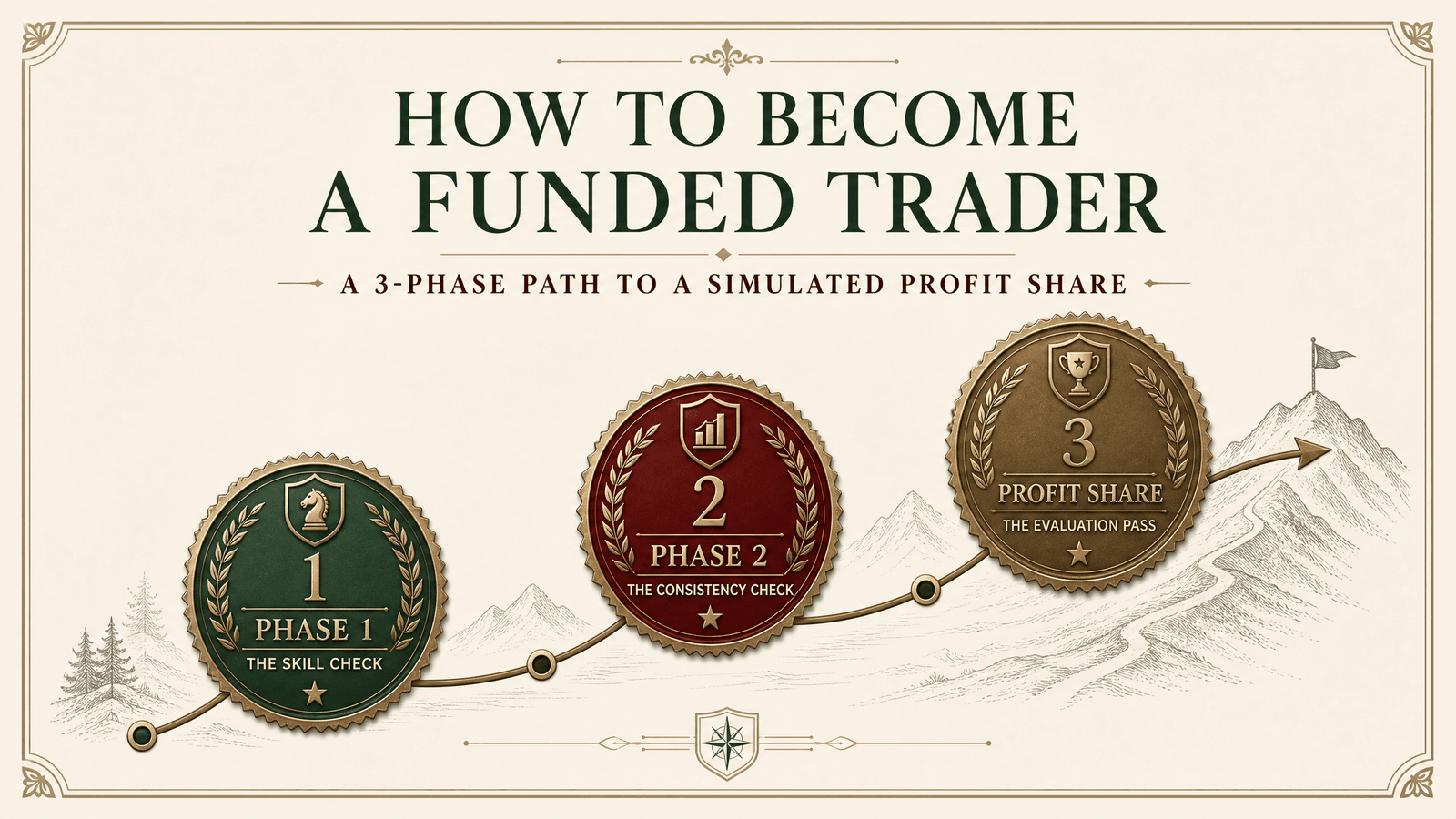
How to become a funded trader in 3 steps
Step 1: Pick a challenge that matches how you actually trade
Every firm runs some version of an evaluation, but the rules differ — profit targets, drawdown limits, how long you have. At TBM, there are two live products:
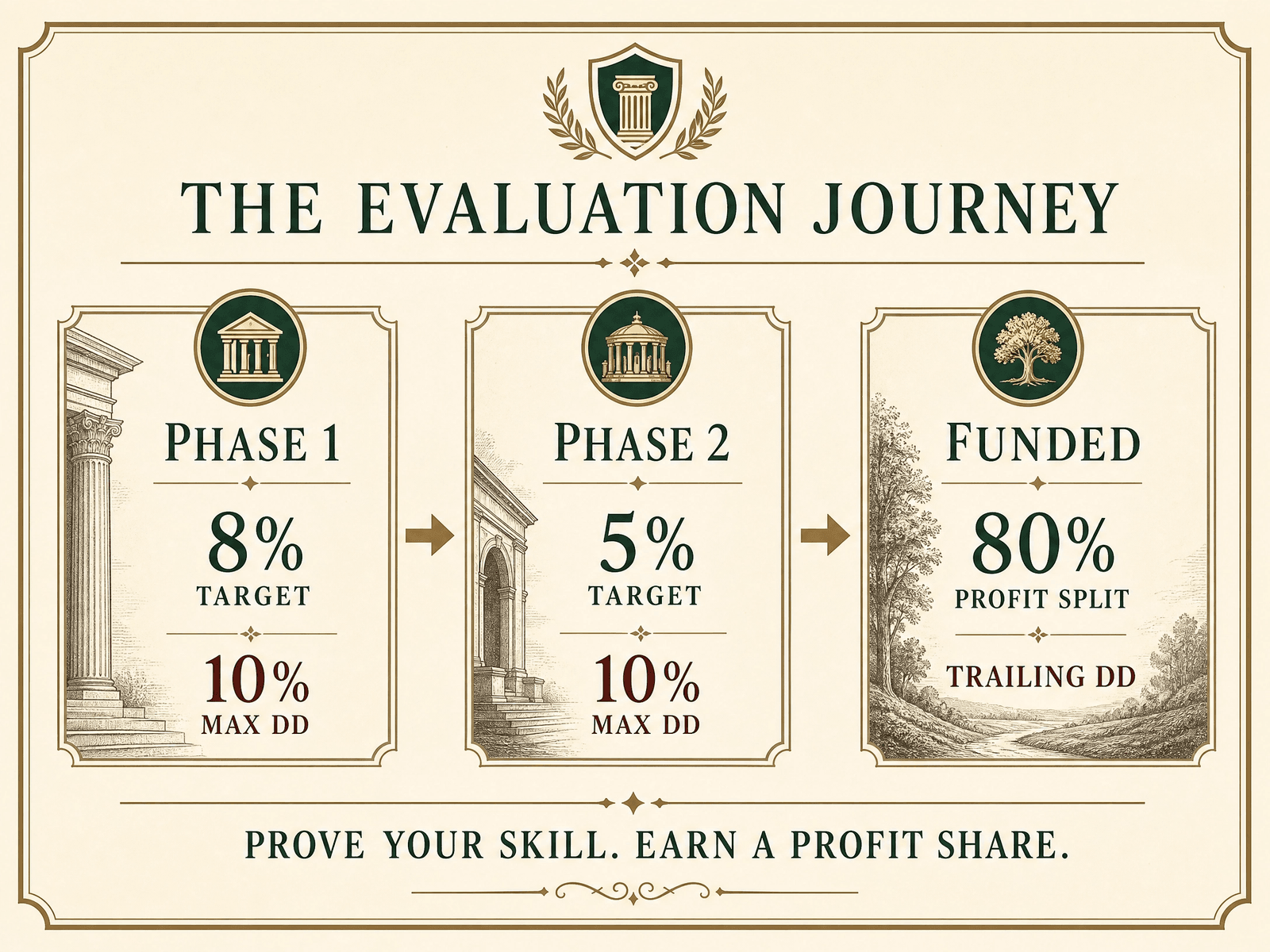
- 2-Phase — the standard evaluation. Phase 1 target 8%, Phase 2 target 5%, 10% max drawdown (static), 5% daily drawdown, no time limit, minimum 5 trading days per phase.
- 2-Step Rapid — more room, a harder target (9% then 6% targets, 10% max drawdown (trailing from day one), 4% daily drawdown, no time limit, minimum 3 trading days, trading days per phase), built for traders who want to get funded faster and are comfortable with a smaller margin for error.
Both run on 1:100 leverage across all instruments. Full numbers are on Pricing.
Step 2: Pass the evaluation — twice
"Passing" means hitting the profit target for that phase without breaching the drawdown limit, and doing it across at least the minimum number of trading days. You do this twice — Phase 1, then Phase 2 — because one good week doesn't prove consistency. Two clean phases does a much better job of separating a real strategy from a lucky streak.
This is also where most attempts actually fail — not from bad trading skill, but from account management. Traders hit their profit target fast, get greedy, and blow through the drawdown limit trying to pad the number further. Slow and controlled beats fast and reckless, every time.
Step 3: Get funded, then get paid
Once you pass both phases, you're issued a funded evaluation account — still simulated capital, but now every dollar you make gets paid to you for real. The rules don't loosen once you're funded. Drawdown mechanics differ by product: on 2-Phase, the evaluation drawdown is static (locked to your starting balance), and it stays static once funded too — no change at the funding milestone. On 2-Phase Rapid, the evaluation drawdown is trailing end-of-day (measured against your highest balance reached), but once funded it switches to static — locked to your funded starting balance, same as 2-Phase. Worth understanding before you get there — see our breakdown on static vs trailing drawdown.
You choose your payout cadence per request — on-demand with no processing fee, or bi-weekly at the higher split with a 3% fee — with a $250 minimum per request and no payout cap. Your first payout requires 14 days plus 3 trading days on the funded account. Split: up to 90% bi-weekly — 60%/80% on 2-Phase (on-demand/bi-weekly), 70%/90% on Rapid.
What evaluations are actually checking
It's not just "make X% profit." Every rule exists to answer one question: can this person be trusted with real payouts?
- Drawdown limits — can you control losses, not just chase gains
- Consistency rule — no single day can be more than 35% of your total profit at payout, so one lucky trade can't carry the whole evaluation
- Max loss per trade — capped at 2% per position, so no single bet can wreck the account
- Minimum trading days — proves the pass wasn't a single all-in gamble
Every one of these is disclosed upfront on How It Works — no fine print you find out about only after a breach.
The mistakes that actually fail people
Overtrading after a good day. Confidence after a win is when most drawdown breaches happen. The rules don't care how good yesterday was.
Ignoring the daily drawdown separately from the max drawdown. These are two different limits. You can be fine on max drawdown and still breach daily drawdown in one bad session.
Using someone else's EA. TBM allows personally-owned EAs with proof of ownership on request. Third-party or commercial EAs, HFT bots, and arbitrage EAs are banned outright — it's a fast way to lose an otherwise-passed evaluation.
Treating Phase 2 like Phase 1. The target is smaller (5% vs 8% on 2-Phase) for a reason — it's testing repeatability, not just your ceiling.
Quick questions
How long does it take to become a funded trader? Entirely up to your pace — there's no time limit on either phase. The only requirement is a minimum of 5 trading days (2-Phase) or 3 trading days (Rapid) per phase.
Do I need a big account to start? No. Evaluations are available across account sizes — see current fees on Pricing.
Is the funded account real money? It's simulated capital — you never deposit your own funds into it — but the payouts you earn from it are real, paid via Rise.
What happens if I fail an evaluation? You can restart. The rules and process stay the same; you're simply starting the phase over.
More questions like these are answered in our full FAQ.
Risk disclaimer: Trading forex and CFDs carries real risk and can result in loss of your capital. Prop firm challenges involve fees and don't guarantee funding or income. This isn't financial, legal, or tax advice — see our full Risk Disclosure.