Prop Firm Challenge $5,000 Account: Cost & Rules
Searching "prop firm challenge $5,000 account" usually means one thing: you want to start small and see if this whole funded-trading thing is even real, without betting a lot on it. Fair question. Here's the actual math — not the marketing version.
At TBM Funded, $5,000 is our smallest size — the Soldier tier, our entry-level prop firm challenge. It's built exactly for this: testing the model before you commit more, without the full prop firm challenge cost of a bigger size.
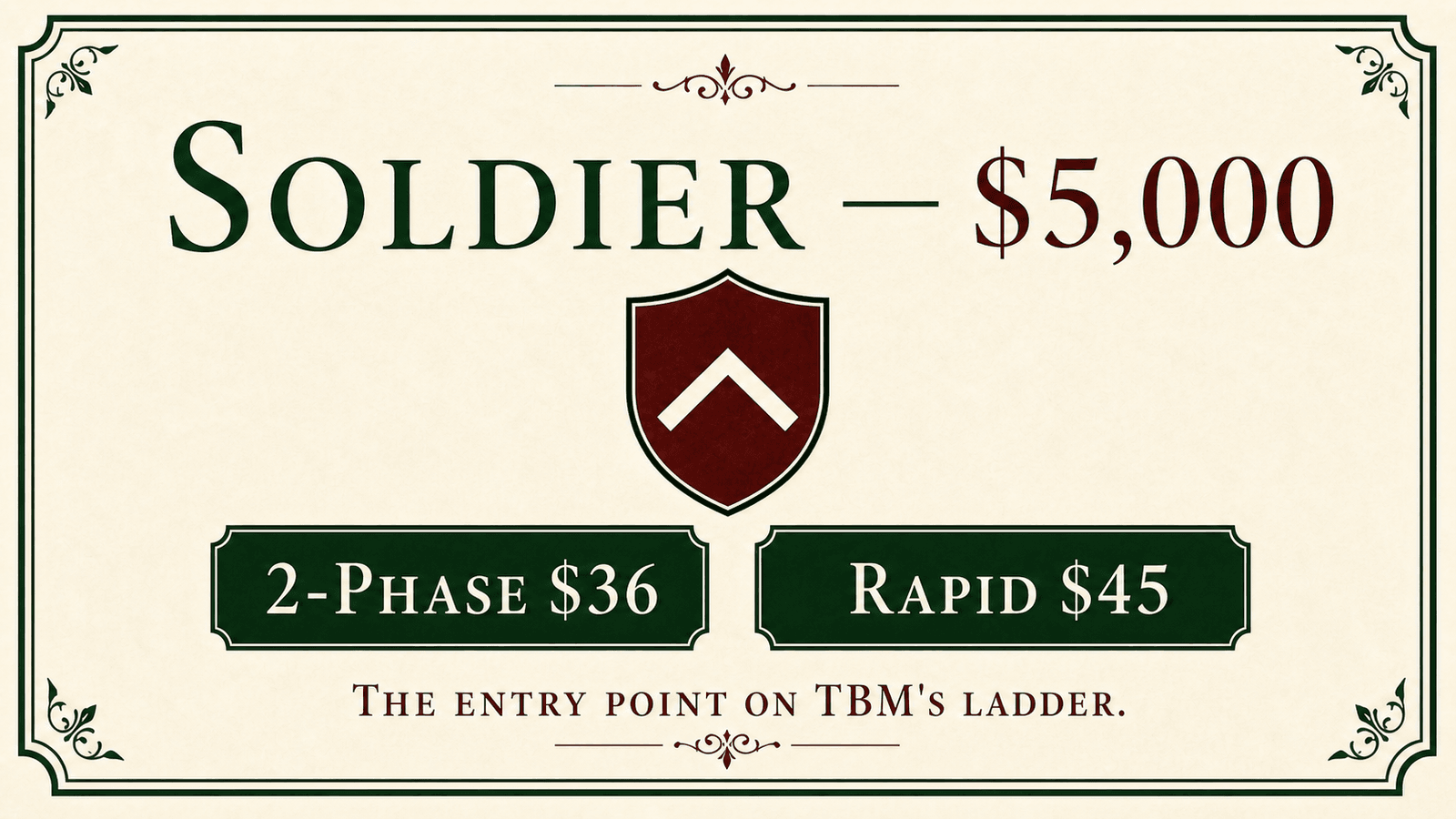
What does a prop firm challenge $5,000 account actually cost?
Two products, two prices, both one-time and paid in USDT — no subscription, no recurring charge.
| Product | Fee | Split once funded |
|---|---|---|
| 2-Step (flagship) | $31 | 80% |
| 2-Step Rapid | $36 | 90% |
That's it. You pay once to attempt the evaluation. You never deposit trading capital — the $5,000 balance is simulated, and it's TBM's number to risk, not yours. If you pass and get funded, the money you earn from it is real and paid out in USDT.
Soldier ($5K) rules at a glance
Here's every number that governs a $5,000 account, side by side, so you're not hunting through two separate pages.
| Rule | 2-Phase | Rapid |
|---|---|---|
| Phase 1 target | 8% | 6% |
| Phase 2 target | 5% | 6% |
| Max drawdown (evaluation) | 10% (static) | 6% (trailing) |
| Daily drawdown | 5% | 3% |
| Min trading days per phase | 5 | 3 |
| Time limit | No time limit | No time limit |
| Leverage | 1:100 | 1:100 |
| Profit split once funded | 80% | 90% |
2-Phase's max drawdown is static during the evaluation — locked to your $5,000 starting balance, so growing the account doesn't shrink your floor. Rapid's evaluation drawdown, by contrast, is trailing end-of-day — it tracks your highest balance reached from day one. Once either product is funded, drawdown switches to (or stays) static — the floor locks at your funded starting balance, at the same percentage. That's no change for 2-Phase, which was already static; for Rapid, it's a shift from the trailing evaluation rule to a static funded floor. Static and trailing are genuinely different rules that get mixed up constantly — we've broken down exactly how in static vs trailing drawdown if you want the full picture.
Who does a $5K challenge actually make sense for?
Three kinds of traders, honestly:
You're new to funded evaluations. A $31 or $36 fee is a cheap way to learn how the rules feel under real conditions — daily drawdown, consistency checks, the works — before you spend more on a bigger size.
You're testing a strategy, not your bank account. If you already trade well but want to see how your system holds up against someone else's rules, Soldier is the low-cost way to find out.
You want proof before you scale. Pass at $5K, and you can requalify at a bigger size later. Nobody's forcing you to jump straight to Don ($100K) on your first attempt.
If you already know you can pass consistently and $31-$36 isn't a meaningful amount to you, there's an argument for starting bigger — the rules are identical across every tier, only the account size and fee change. Full breakdown of every tier's rules lives on How It Works.
What can you realistically expect from your first payout?
This is the part most articles skip, and it matters more at $5K than at any other size.
Your first payout becomes available after 14 days on the funded account, plus a minimum of 3 trading days. So far, same for everyone. From there, you choose your cadence per request — on-demand with no processing fee, or bi-weekly at the higher split with a 3% fee — and there's no cap on how much any payout can be.
Here's the part specific to smaller accounts: the $250 minimum payout matters more on a $5,000 balance than it does higher up the ladder. On Soldier, $250 is 5% of your starting balance — you need a real, profitable stretch before a request clears the floor, not just one green day. On a Don ($100K) account, that same $250 minimum barely registers by comparison.
Run the numbers honestly: on 2-Phase, you'd need at least $313 of profit before your 80% bi-weekly share reaches the $250 minimum (or $417 before your 60% on-demand share does). Either way, that's real, sustained performance on a $5,000 account, not a lucky trade.
Bottom line — a small prop firm account like Soldier is a real way to get paid, but reaching your first payout on a $5,000 funded account takes more consistent profit, proportionally, than it does on a bigger size. That's the honest trade-off for the lower entry fee.
2-Phase vs Rapid at $5K: which one fits you?
2-Phase gives you more room — 8%/5% targets, wider 10% drawdown, 5 trading days minimum per phase — in exchange for the lower 80% split. Rapid trades more room for a harder target (9% then 6% targets, 10% trailing drawdown, minimum 3 trading days) and pays 90% once you're funded, but the tighter drawdown means less margin for a bad week.
Neither is "better" — they're built for different trading styles. If you're still deciding, Pricing shows both side by side with live numbers for every account size, not just Soldier.
Quick questions
Do I need $5,000 of my own money to start? No. The $5,000 is simulated capital TBM provides once you pass the evaluation. You only ever pay the one-time evaluation fee — $31 for 2-Step or $36 for 2-Step Rapid.
Is $5,000 too small to make real money from? It's the smallest tier, so the $250 minimum payout is proportionally the biggest hurdle here — you'll need a real profitable stretch to clear it, not just one green day. Real money still moves for real; it's just a bigger climb to your first payout at this size than at Boss or Don.
Can I upgrade to a bigger account later? Yes. Passing a $5K evaluation doesn't lock you in — you can attempt a larger size whenever you're ready, at that tier's own fee.
Is the drawdown different at $5K than at bigger sizes? No. Drawdown percentages are identical across every account size for a given product — 10%/5% on 2-Phase, 6%/3% on Rapid. Only the dollar amount they represent changes with balance.
More questions like these are answered in our full FAQ.
For the complete 2-Phase rulebook — fees, EA policy, and every clause in one place — see TBM Funded 2-Phase Challenge Rules.
Risk disclaimer: Trading forex and CFDs carries real risk and can result in loss of your capital. Prop firm challenges involve fees and don't guarantee funding or income. This isn't financial, legal, or tax advice — see our full Risk Disclosure.