Legion Funding Review 2026: Rules, Payouts & Red Flags
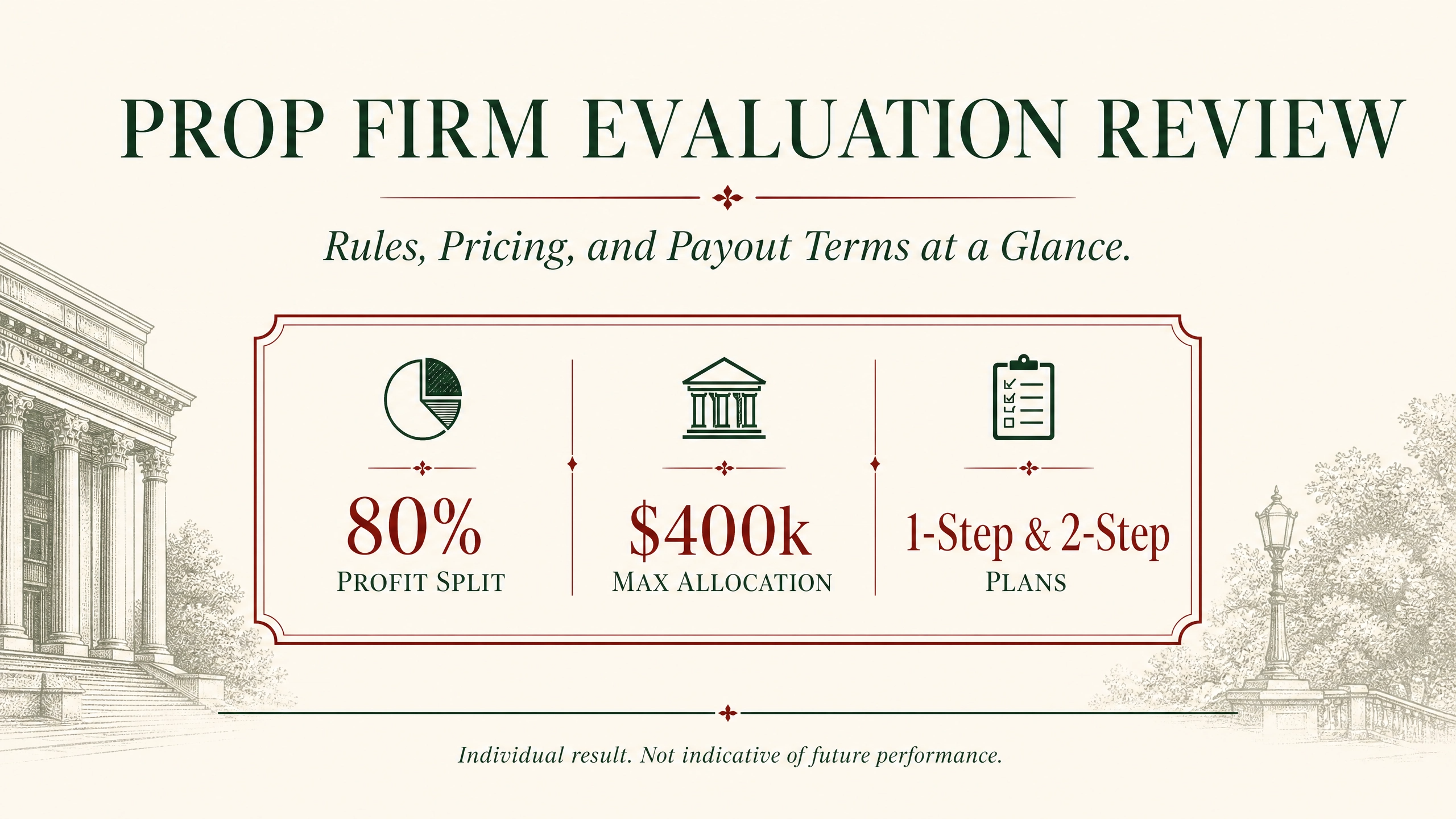
Legion Funding is a prop trading firm offering 1-Step, 2-Step, and Instant Funding evaluations on accounts up to $400,000, with an 80% profit split and a scale-up program. Daily drawdown runs 3-4% and max drawdown 5-8% by plan. This review covers its published rules, payouts, and what to verify before paying.
What Is Legion Funding?
Legion Funding markets itself under the line "Trade With Our Capital. Keep The Profits." It runs the now-familiar prop trading model: a trader pays an upfront fee to attempt a simulated evaluation, and if they hit the profit target while staying inside the drawdown limits, they move to a funded account and get paid a share of the profits they generate from that point forward.
The firm's own site does not publish a registered legal entity name, incorporation jurisdiction, or regulatory status anywhere we could access. That's not unusual in this industry — most prop firms operate as private companies rather than regulated brokers — but it's exactly the kind of detail worth confirming directly with the firm before committing money, which we cover in the checklist below.
Evaluation Types and Rules
Legion Funding's FAQ describes three evaluation structures:
| Plan | Structure | Profit Target | Max Drawdown | Daily Drawdown |
|---|---|---|---|---|
| 1-Step | Single phase | 10% | 6% | 3-4% |
| 2-Step | Two phases | 8% (Phase 1), lower target Phase 2 | 8% | 3-4% |
| Instant Funding | No evaluation | N/A | 5% (trailing) | Not separately listed |
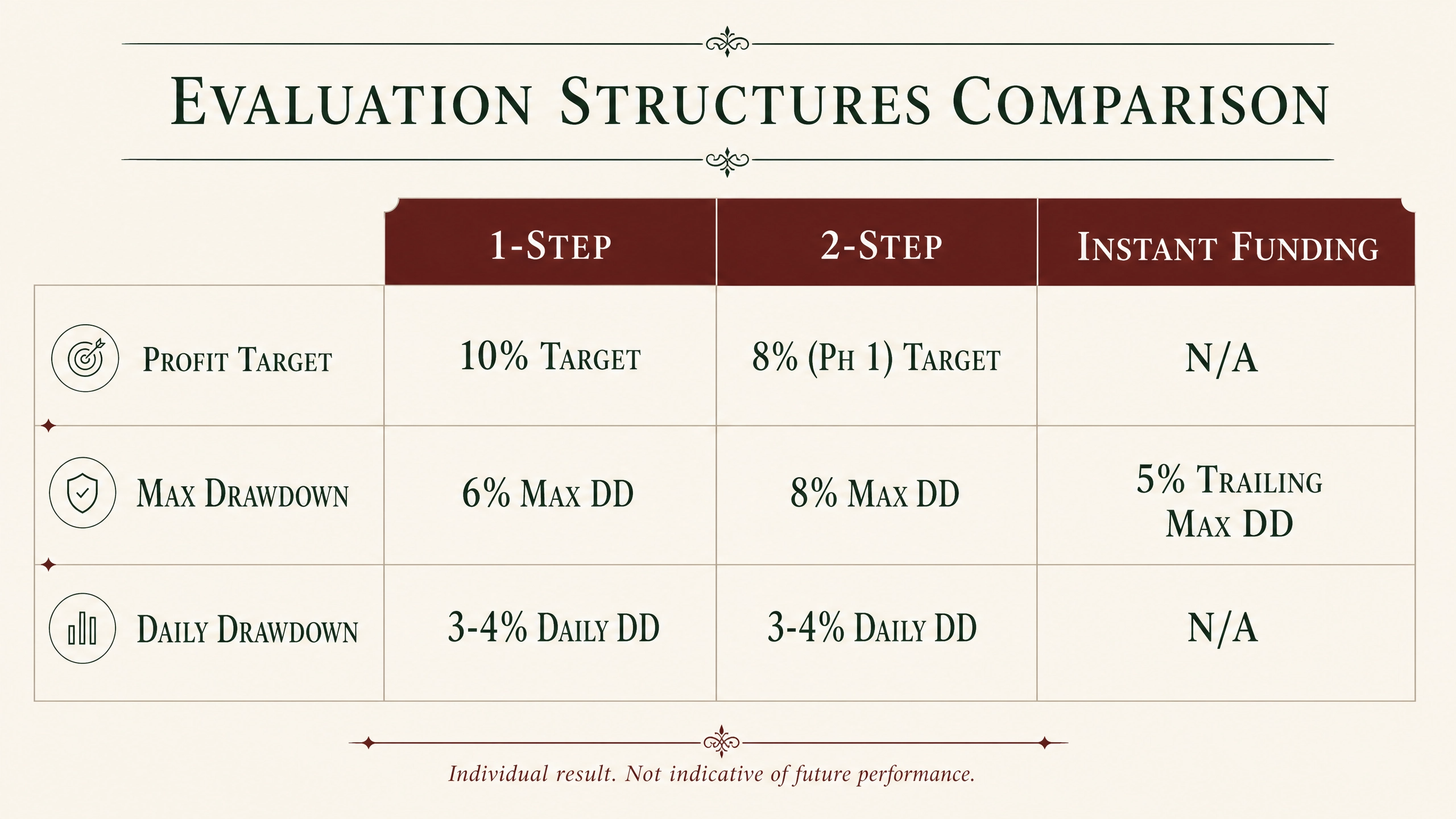
A live discrepancy worth knowing about: Legion Funding's own FAQ text and its own interactive pricing calculator disagree with each other on the 2-Step numbers — the FAQ states 8%/6% targets with an 8% max drawdown (reflected above), while the calculator on the same page shows 8%/5% targets with a 10% max drawdown for the same plan. The calculator also lists a fourth plan tab, "Fast Track," that the FAQ text doesn't mention at all. Interactive pricing tools tend to get updated more often than FAQ copy, so treat the calculator as the more current source and confirm the exact numbers for your target account size directly before paying.
Legion Funding advertises its challenges as having no overall time limit to hit the profit target. Funded ("master") accounts carry additional trading rules, including a requirement to attach a stop loss within 30 seconds of opening a position, plus restrictions around trading through news events. Specific figures for the consistency rule and minimum active trading days were not clearly published on the pages reviewed for this piece — confirm both directly, since they can affect whether a payout gets approved even after a target is technically hit. (For context on how a consistency rule works elsewhere in the industry, see our breakdown of the prop firm consistency rule.)
Profit Split and Scaling
Legion Funding's own site confirms an 80% profit split for funded traders, and describes its Scale-Up Program in these words: after every 3 months of profitable trading, funded account size increases by 25%, up to a maximum allocation of $400,000, with the payout split also increasing as the account scales. As with any scaling program, the practical payout depends on actually sustaining profitability quarter over quarter — the marketing figure describes the ceiling, not a guaranteed trajectory.
Payouts and Refund Policy
Per Legion Funding's own FAQ, payout requests are processed within 24 hours on business days, with a stated minimum withdrawal threshold of $100 and no fixed request cadence — traders can request once the account clears that threshold. The firm also states that the evaluation fee is refunded in full, "along with your profit withdrawal," once a trader passes the evaluation and receives the fourth payout from the resulting funded account.
That refund structure is worth reading carefully: it's contingent on reaching a specific funded-account payout milestone, not on passing the evaluation alone. Treat "the fee is refundable" as a conditional claim, not a guarantee that applies from day one.
Platforms and Tradable Instruments
Legion Funding's FAQ states plainly: "We currently support MetaTrader 5, and more platform options are on the way" — worth reading as MT5-only for now, not multi-platform. Supported asset classes span forex, indices, metals, energies, and crypto pairs, a fairly standard instrument list among newer challenge-style firms. The site also states active funded traders across 50+ countries, though a specific total trader count wasn't available as a fixed, citable figure.
Who Is Promoting Legion Funding?
Legion Funding has drawn visibility partly through creator promotion. Trading content creator Umar Punjabi ("The Alpha Trader") has been promoting Legion Funding on YouTube — a video on his 2.1M-subscriber channel links directly to Legion Funding's signup page in the description. It's worth being precise here: promotion is not the same as ownership. Formal ownership or founder status of Legion Funding by any individual promoter is not publicly confirmed, and a creator posting about a firm doesn't by itself establish an equity, operational, or leadership role. Treat sponsored or affiliate-style content the way you'd treat any paid promotion — as marketing, not independent verification.
What to Verify Before You Pay (Any Prop Firm)
This checklist applies to Legion Funding or any other evaluation-style prop firm you're considering — not just this one. If you want to see how one firm structures this disclosure, TBM Funded's own How It Works and Pricing pages publish targets, drawdown, and fees up front — a useful reference point regardless of which firm you evaluate.
- Jurisdiction and legal entity. Find the actual registered company name and where it's incorporated, usually buried in the terms of service or footer. A firm that's vague about this on its main pages should at least be clear about it in its legal documents.
- Independent payout evidence. Look for payout confirmations that exist outside the firm's own marketing — third-party review platforms, dated screenshots with visible transaction IDs, or payout trackers the firm doesn't control. Marketing-page testimonials alone aren't evidence, and a firm with no independent review footprint yet simply means there's nothing to check either way — not a red flag by itself, but not confirmation either.
- Support responsiveness. Before you pay, send a real question to support (about drawdown calculation, a specific rule, or refund mechanics) and time the response. How a firm answers a pre-sale question is a reasonable proxy for how it handles a payout dispute later.
- Refund mechanics, read literally. If a firm advertises a refundable fee, find the exact condition — refundable on passing, refundable after a certain number of funded payouts, or refundable only in specific circumstances. These are very different promises that get shortened to the same marketing line.
- Country and payment restrictions. Confirm which payment methods the firm actually accepts for your region before starting a checkout flow. Card issuers in many regions routinely decline cross-border charges to trading-related merchants, which can strand a trader mid-purchase — and separately, check whether payouts move on a rail you can actually receive, since a firm's payout-speed claims are only useful if the rail reaches you at all.
- Similarly-named entities. Names in this industry repeat and overlap. Before entering payment details anywhere, double-check that the domain and legal entity you're actually paying match the one you researched — impersonator sites and copycat names are common enough to be worth the extra ten seconds.
- Internal consistency. If a firm's own FAQ and its own pricing calculator show different numbers for the same plan, that's worth resolving with support before you pay, not after.
None of this is specific to any one firm's trustworthiness — it's the same due-diligence pass worth running before paying any evaluation fee, anywhere.
FAQ
Is Legion Funding a legitimate prop trading firm? Legion Funding is an active, publicly marketed prop trading firm offering evaluation-based and instant funding accounts. Legitimacy in this industry isn't binary — it comes down to whether a firm's stated terms, payout track record, and support responsiveness hold up when checked directly, which is what the verification checklist above is for.
How much does a Legion Funding evaluation cost? Legion Funding does not prominently publish a fixed per-account-size price list on the pages reviewed for this piece. Confirm current pricing for your target account size directly on Legion Funding's checkout pages before comparing it to other firms.
What is Legion Funding's profit split? Legion Funding states an 80% profit split for funded traders, with account size eligible to grow through its Scale-Up Program (a stated +25% every three months of profitable trading, up to a $400,000 ceiling) and the split increasing as the account scales.
Does Legion Funding offer instant funding without an evaluation? Yes. Alongside its 1-Step and 2-Step evaluations, Legion Funding lists an "Instant Funding" plan with no evaluation phase and a 5% trailing drawdown limit, according to its published FAQ.
Is Umar Punjabi the founder of Legion Funding? No public confirmation of that exists. Umar Punjabi has promoted Legion Funding on YouTube, linking directly to their signup page in a video description, but promotion is not the same as ownership, and Legion Funding's formal ownership structure is not publicly disclosed on the pages reviewed for this piece.
More rule and payout questions like these are answered in our full FAQ.
Risk disclaimer: Trading forex and CFDs carries real risk and can result in loss of your capital. Prop firm challenges involve fees and don't guarantee funding or income. This isn't financial, legal, or tax advice. This article summarizes publicly stated third-party terms as of the verification date above and is not a recommendation, endorsement, or partnership disclosure — see our own Risk Disclosure.
Last updated: July 12, 2026