How to Choose a Prop Firm for Your Trading Style
How to choose a prop firm for your trading style comes down to one question most traders skip: does this firm's rulebook actually let me trade the way I trade?
Every firm advertises the same things — funding, splits, "no time limits" (usually a lie, ask for the real number). What they don't put on the homepage is whether their daily drawdown limit will strangle a scalper, or whether their EA policy will disqualify your algo on day one. That's the part that actually decides whether you pass.
How to choose a prop firm for your trading style: start here
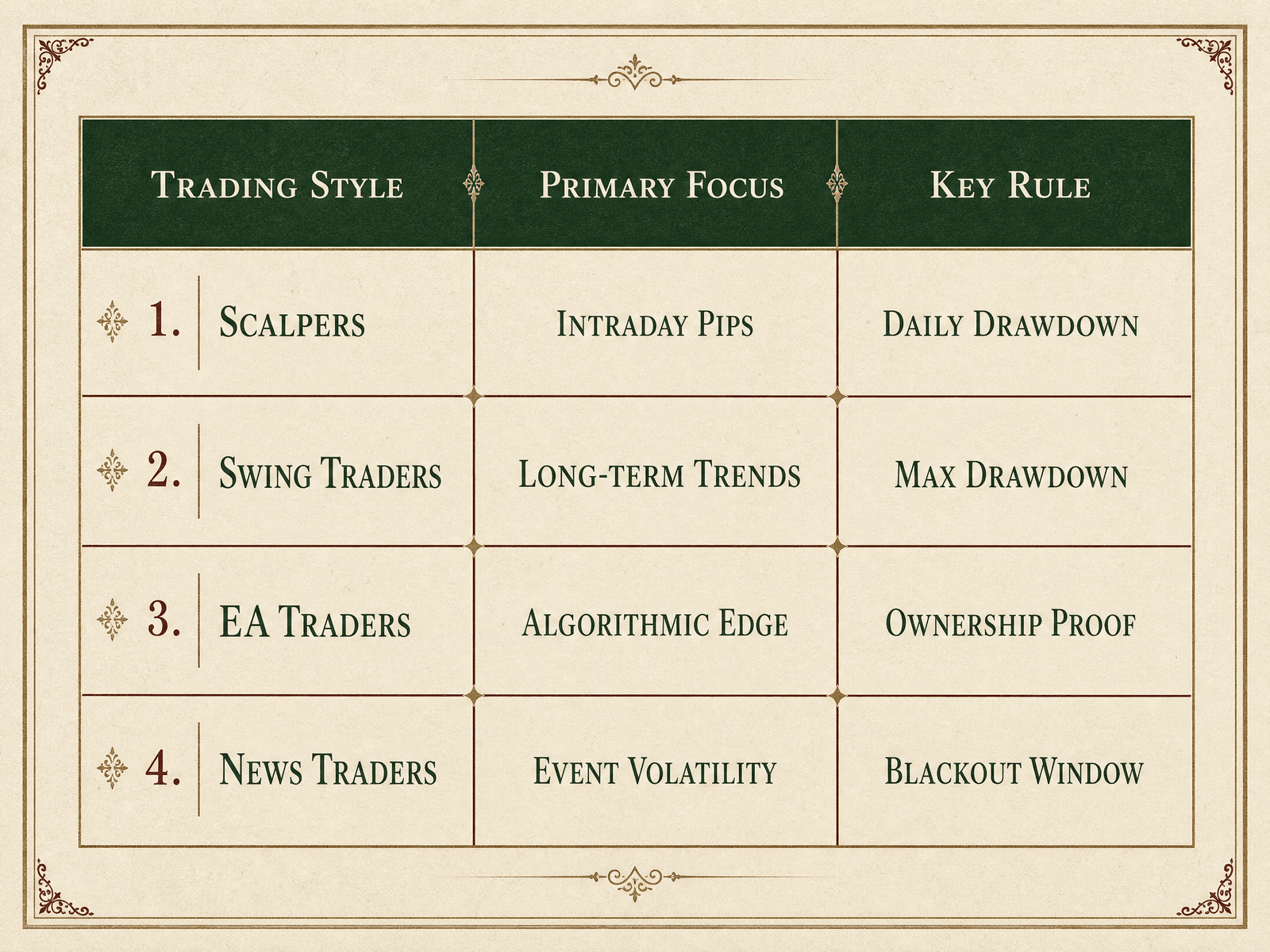
Before comparing firms, be honest about how you actually trade. The four common styles, and what breaks them:
Scalpers and high-frequency intraday traders
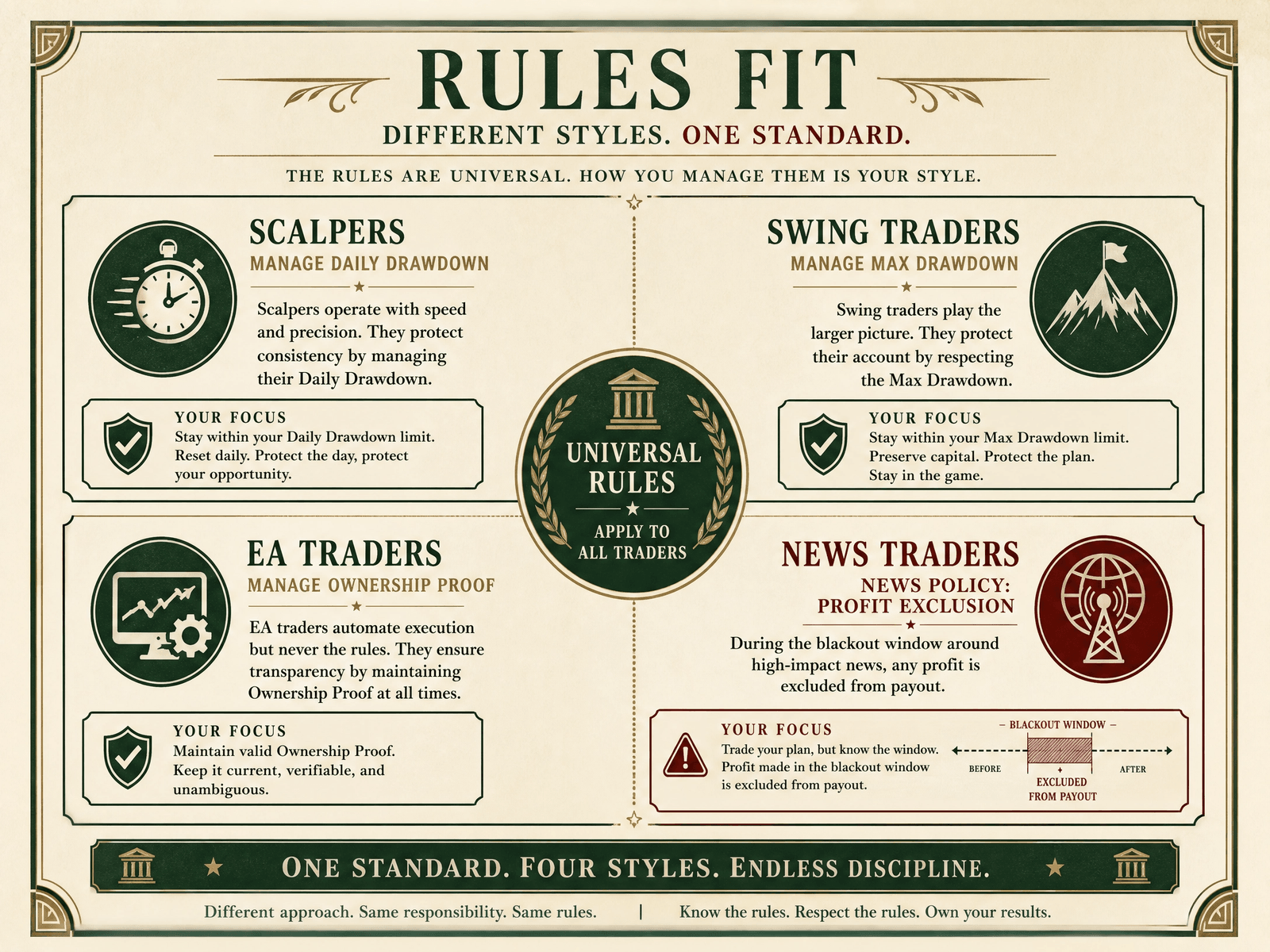
Watch the daily drawdown, not just the max drawdown. A tight daily limit (like 3% on TBM's Rapid) punishes a bad morning session hard, even if your overall account is healthy. If you take dozens of trades a day, a firm with a tighter daily limit demands tighter per-trade discipline — not necessarily a dealbreaker, but know what you're signing up for.
Also confirm the firm's stance on latency arbitrage or tick-scalping specifically — most firms, TBM included, ban it outright as a prohibited strategy, separate from the drawdown rules.
Swing traders holding positions for days
You need room. Look at the max drawdown relative to how far your typical stop sits, and check the minimum trading days requirement — a firm demanding 10+ active trading days per phase doesn't suit someone who might only place 4-5 trades in a month. TBM's 2-Phase requires 5 minimum trading days per phase; Rapid requires 3. Neither punishes a slower cadence the way a higher-day-count firm would.
EA and algo traders
This is the fastest way to get disqualified if you skip it. Read the EA policy line by line. TBM allows personally-owned EAs with proof of ownership available on request — a purchase receipt, source code, or a licence in your own name. What's banned: third-party or commercial EAs, HFT bots, and arbitrage EAs — all treated as a rule violation serious enough to end the evaluation. If your edge is a bot you didn't build yourself, confirm this before you pay for an evaluation, not after.
News traders
Firms almost universally restrict trading around high-impact news. On TBM, there's a 5-minute blackout window around red-folder news events — but the enforcement is worth understanding: profit made inside that window is excluded from payout calculations, not treated as an automatic breach. That's a meaningfully different (and fairer) approach than firms that terminate accounts outright for a single news-window trade.
The rules that matter more than the split
Everyone compares profit split first. It matters less than people think if the rules underneath don't fit your style — a higher split on an account you can't actually pass is worth nothing. Before comparing splits, compare:
| What to check | Why it matters |
|---|---|
| Daily vs max drawdown | Determines how much room a single bad session costs you |
| Static vs trailing drawdown | Static (locked to starting balance) is friendlier during evaluation; funded accounts trail your highest balance industry-wide — confirm which applies at which stage |
| Minimum trading days | Punishes styles that trade infrequently if set too high |
| EA/bot policy | Can disqualify an algo strategy instantly if unread |
| News-event handling | Some firms terminate on a single news-window trade; others (like TBM) exclude the profit instead |
| Time limit per phase | No time limit on either TBM product — confirmed, not marketing spin |
(Live numbers always on Pricing and How It Works.)
Where TBM's two products fit
If you're deciding between TBM's own products specifically: 2-Phase (8%/5% targets, 10% max drawdown — static in evaluation, 5% daily, 5 min trading days) suits traders who want more room to breathe across a slower, steadier pace. 2-Phase Rapid (6%/6% targets, 6% max drawdown — trailing from day one of the evaluation, 3% daily, 3 min trading days) suits traders who move fast and want funded faster, in exchange for a tighter margin for error — and a higher split, up to 90% (70% on-demand, 90% bi-weekly) against 2-Phase's up to 80% (60% on-demand, 80% bi-weekly).
Read more about how drawdown is measured at each stage on our static vs trailing drawdown post before you decide.
Quick questions
Is a higher profit split always the better deal? No. A split you never collect because the rules don't fit your style is worse than a lower split you can actually pass. Match the rules first.
Can I use my own trading bot? Yes, if you built and own it — proof of ownership required on request. Third-party, commercial, HFT, and arbitrage bots are banned outright.
Does trading during news always break the rules? Not on TBM — profit made inside the 5-minute news blackout window is excluded from your payout calculation rather than treated as a violation.
What's the actual difference between 2-Phase and Rapid? Rapid has tighter drawdown limits (trailing from day one) and fewer required trading days, funds you faster, and pays up to a 90% split (70% on-demand, 90% bi-weekly). 2-Phase has more breathing room, a static evaluation drawdown, and pays up to 80% (60% on-demand, 80% bi-weekly).
More rule questions like these are answered in our full FAQ.
Risk disclaimer: Trading forex and CFDs carries real risk and can result in loss of your capital. Prop firm challenges involve fees and don't guarantee funding or income. This isn't financial, legal, or tax advice — see our full Risk Disclosure.