Buy A Prop Firm Challenge With Crypto: The Real Steps
Buying a prop firm challenge with crypto comes down to one thing: sending the right amount, of the right stablecoin, on the right network. At TBM Funded, that means USDT on the TRC20 network — checkout won't accept anything else, and the whole process from payment to account activation usually takes minutes, not days.
If you've never paid for anything with crypto before, the idea of "sending USDT" can feel more intimidating than it should. It's not. Here's exactly what happens, step by step, and what you need before you start.
Why TBM Only Takes USDT (The Short Version)
TBM Funded's checkout runs on USDT (TRC20) only — no cards. That's not a preference thing. Card payments for prop firm evaluations get declined constantly because of how card networks classify trading-related merchants, cross-border risk, and card-not-present fraud scoring.
We've written the full breakdown of why that happens in Why Prop Firm Payments Keep Getting Declined — worth reading if you want the mechanics. For this post, the short version is enough: crypto settles without a card network or an issuing bank in the loop, so it clears where cards routinely don't.
What You Need Before You Start
You don't need a crypto trading account or any trading experience. You need three things:
- A wallet or exchange account that holds USDT. USDT is a stablecoin — pegged 1:1 to the US dollar, so the amount you owe doesn't swing with crypto market prices the way BTC or ETH would. Most major exchanges (and most self-custody wallets) support it.
- The ability to send on the TRC20 network specifically. USDT exists on multiple networks — TRC20, ERC20, and others. TBM's checkout only accepts TRC20. Sending on the wrong network doesn't fail safely; it can strand your funds, so this is the one step worth double-checking every time.
- A few minutes. TRC20 network confirmations are typically fast, usually just a handful of minutes.
How to Buy a Prop Firm Challenge With Crypto, Step by Step
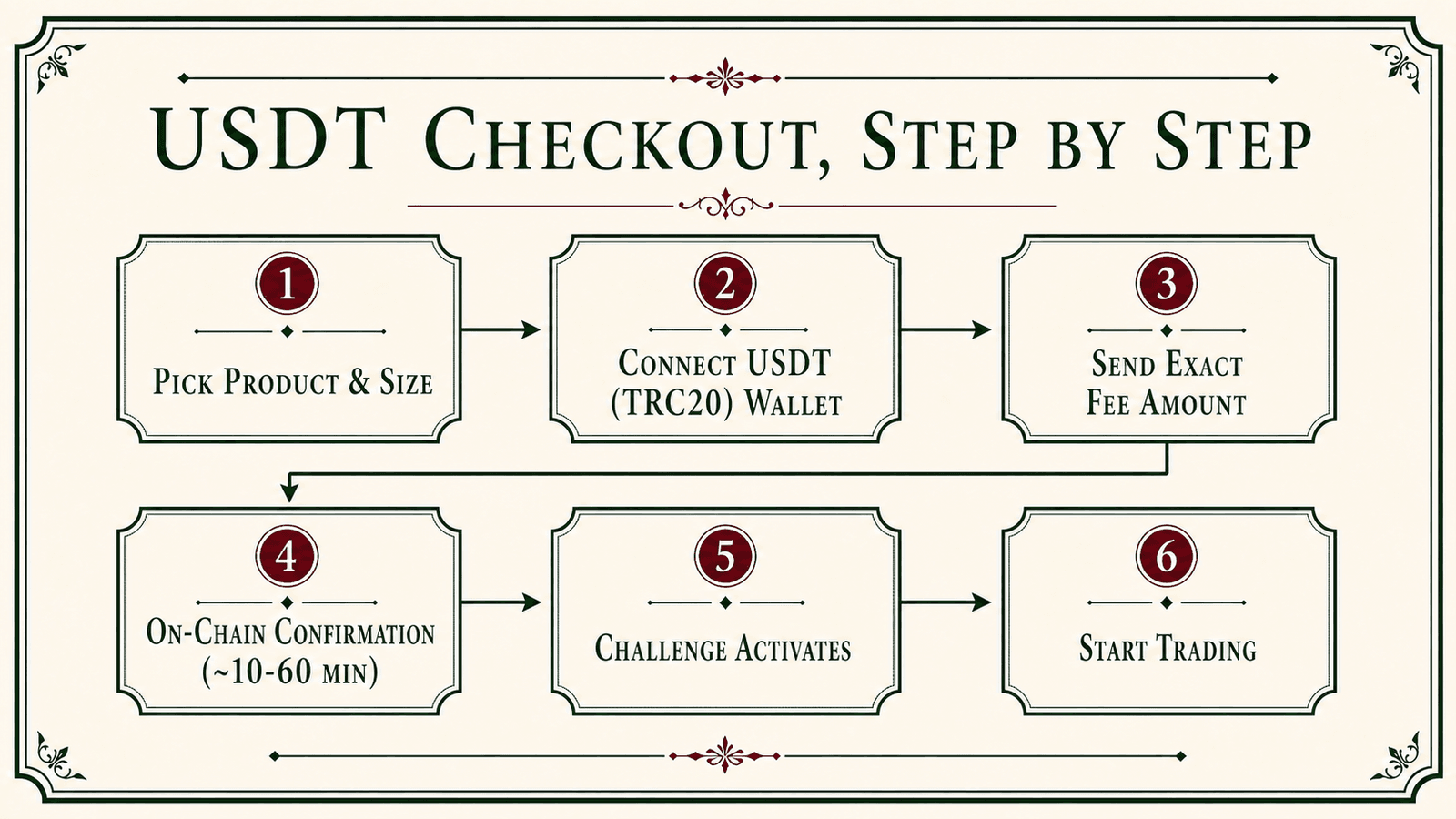
- Pick your product and account size on /pricing — 2-Phase or 2-Phase Rapid, at Soldier ($5K) through Don ($100K).
- Go to checkout. TBM generates a unique USDT (TRC20) deposit address and the exact amount owed for your tier — you're not guessing at a conversion rate.
- Open your wallet or exchange, select USDT, and confirm the network is set to TRC20 before sending. This is the step that matters most.
- Send the exact amount shown to the address shown. Crypto payments are irreversible once sent, so a quick copy-paste check (not a manual retype) of the address is worth the ten seconds.
- Wait for network confirmation. You'll see a pending state in checkout while the transaction confirms on-chain.
- Your challenge activates automatically once payment clears — no manual approval step, no waiting on a support ticket. Phase 1 rules start from there.
That's the entire flow. There's no separate "funding" step after this — the fee you just paid is the one-time evaluation fee, full stop.
The Real Fees, By Account Size
These are TBM's live checkout fees — one-time, in USD, paid in the USDT-equivalent amount at checkout. No hidden add-ons.
| Tier | Size | 2-Step fee | 2-Step Rapid fee |
|---|---|---|---|
| Soldier | $5,000 | $31 | $36 |
| Capo | $10,000 | $54 | $61 |
| Mad Men | $25,000 | $120 | $134 |
| Boss | $50,000 | $220 | $263 |
| Don | $100,000 | $363 | $470 |
Rapid costs more at every size because the rules are tighter and the payout terms are better — full comparison in How It Works. If you want the actual pass/fail rules for the 2-Phase evaluation before you commit, see TBM Funded's 2-Phase Challenge Rules.
What Actually Happens to Your Money
This is the part people get wrong most often, so it's worth being blunt about it. The USDT you send at checkout isn't capital you're depositing into a trading account. It's a one-time evaluation fee.
Your funded account, if you pass, trades simulated capital — you're never funding it and never risking additional money beyond the fee you already paid. What's real is the payout: once you're funded and hit target, profit comes back to you for real. You choose the cadence per request — on-demand with no processing fee, or bi-weekly at the higher split with a 3% fee — with a $250 minimum per request, first payout available after 14 days plus 3 trading days on the funded account (evaluation days don't count toward this).
You pay once at checkout, in crypto. Payouts use TBM's own designated payout method, published in your portal — a separate rail from checkout, not the same one run in reverse.
FAQ
Do I need a crypto exchange account to buy a prop firm challenge? You need something that holds USDT and can send it — that's a major exchange account or a self-custody wallet. Either works, as long as it supports sending on the TRC20 network.
What happens if I send USDT on the wrong network? It can strand the funds — crypto transactions on the wrong network usually aren't automatically recoverable. Always confirm TRC20 is selected before you send, not after.
How long does it take for my challenge to activate after I pay? Once the TRC20 transaction confirms on-chain, activation is automatic — no manual review step on TBM's end. Confirmation itself is typically a few minutes.
Can I pay with Bitcoin or Ethereum instead of USDT? No. TBM's checkout runs on USDT (TRC20) only, so the amount you owe is fixed and doesn't move with crypto market prices the way BTC or ETH would.
Is buying a prop firm challenge with crypto safe? The payment itself is as safe as any USDT transfer — double-check the address and the network, and it settles cleanly. Separately, always verify a firm's checkout is real (an actual generated address and order record, not a personal wallet request) before sending anything.
More on payment mechanics in our full FAQ.
Risk disclaimer: Trading forex and CFDs carries real risk and can result in loss of your capital. Prop firm challenges involve fees and don't guarantee funding or income. This isn't financial, legal, or tax advice — see our full Risk Disclosure.
Last updated: July 15, 2026.